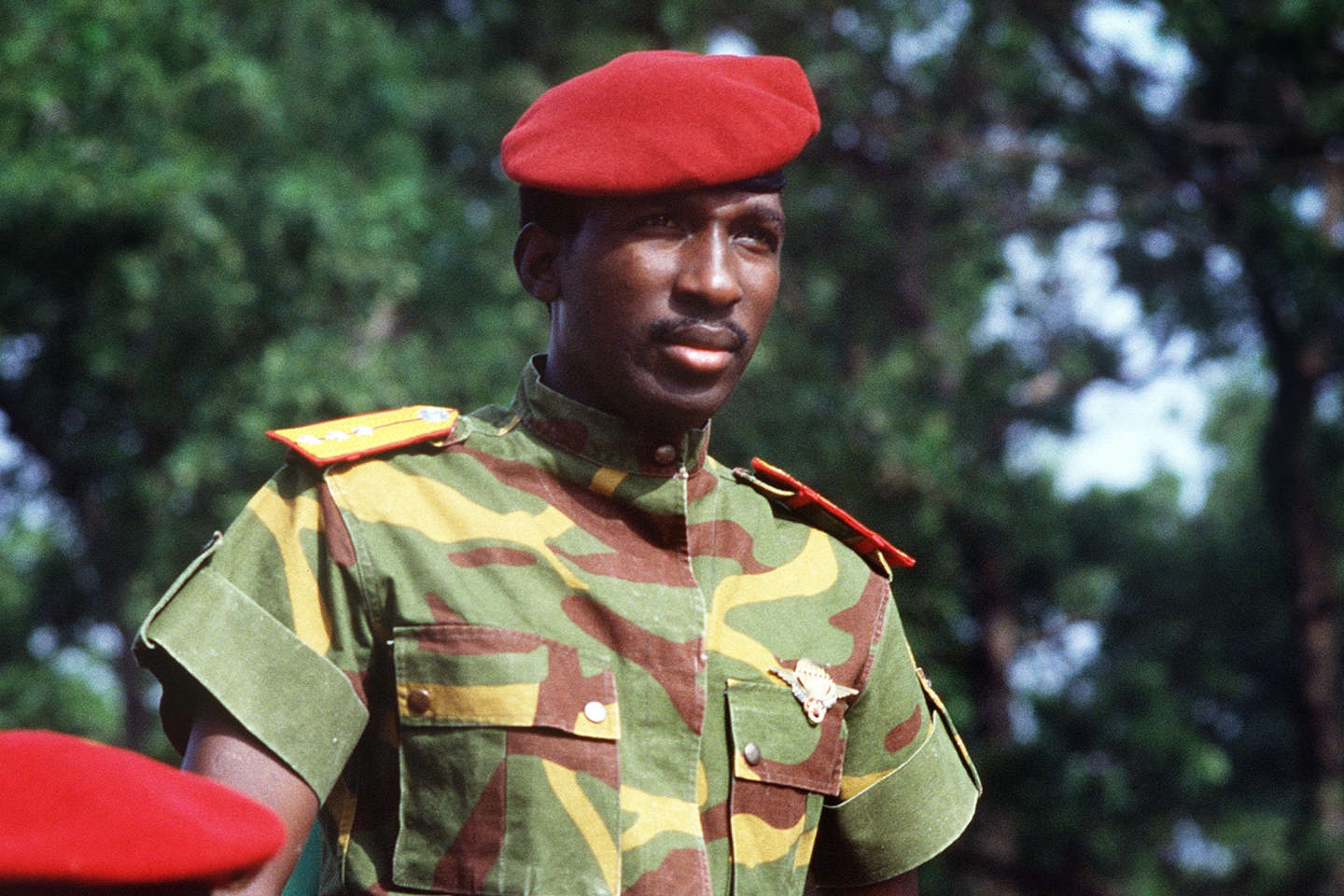
Homeland or death, we shall overcome.
Thomas Sankara

Thomas Isidore Noël Sankara was born in 1949 in Yako, in the northern region of Burkina Faso, then Upper Volta. He was one of twelve children of a Mossi mother, the most numerous ethnic group in the country. His father, Joseph Sankara, was Fulani. He was a veteran and prisoner of the Second World War, a Senegalese rifleman (tirailleur).
Far from the political world, Thomas first wanted to become a surgeon. But that ignored the corruption he already knew very early on. Indeed, the scholarship that should have allowed him to follow a medical path was stolen by another student, whose family knew the workings of corruption well.
So, in despair, he began training at the inter-service military school of Yaoundé in Cameroon and finished at the military school of Antsirabe in Madagascar. It was there that he witnessed the great Malagasy turn towards socialism, which fascinated him. He also perfected his French there, and became the great orator in that language that we know today.
Thomas was an exemplary student, and for that he was offered the most prestigious command in the army. He became the most famous soldier in Upper Volta and had the chance to choose his own deputy, his faithful friend: Blaise Compaoré (the man who would succeed him, in circumstances we will see). Together they formed the Regroupement des officiers communistes (ROC), strongly left-leaning or even far-left, whose other best-known members were Henri Zongo and Jean-Baptiste Boukary Lingani.
His rise to power
Thomas Sankara’s political engagement began in 1981 when he was appointed secretary of state, then minister. He took power in a coup on 4 August 1983 and launched the Burkinabè revolution.
At his side were the two influential revolutionary parties of the capital: the Voltaic Communist Union, of Maoist tendency, and the African Independence Party.
The poorest layers of the population were his supporters. He came to power to the sound of traditional instruments and clapping hands. The first signs of change arrived: Upper Volta was no more.
Revolution on every front.
The change began with a masterstroke that had the merit of being clear. All the Mercedes owned by members of the government under the old regime were replaced by Renault 5s. The aim was to show the break with the old privileges. From now on ministers no longer travelled in business class or by private jet, they all travelled in the same conditions as tourists. Their allowances were also abolished. The revolution implied certain sacrifices, beginning by putting everyone on an equal footing.
As a leader you must be upstairs, which lets you see very far; but from time to time, you have to come down to the ground floor to also see what is happening in the street.
Thomas Sankara
In the second part of this article, which cannot do justice to the life of the founder of the “land of upright men”, we will discover how Sankara fought head-on against imperialism, which he judged to be his fiercest enemy, and how his policies marked the history of an entire nation.
Thomas Sankara was a man of many battles. Among others, he fought against embezzlement, capitalism, patriarchy, imperialism, colonialism, racism… and he turned words into action.