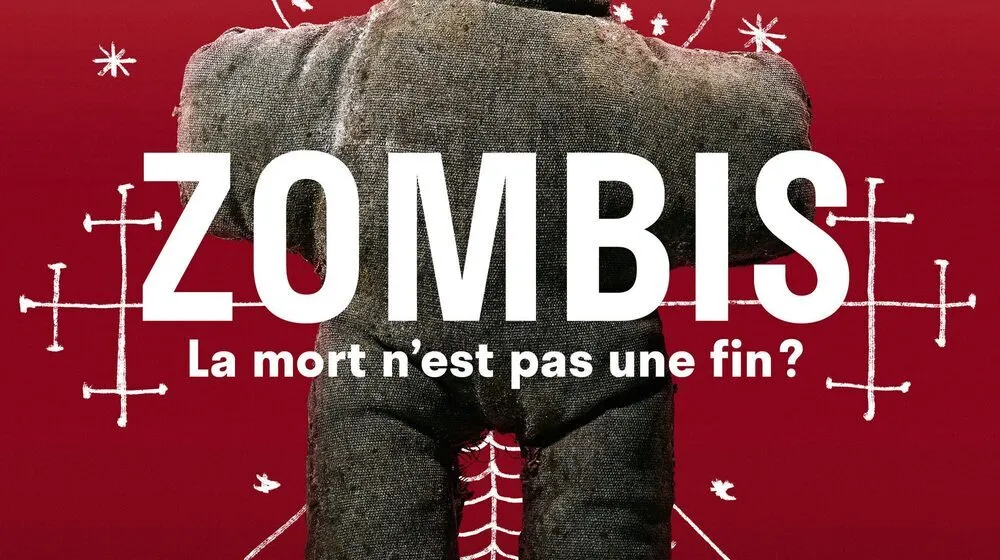
On the east mezzanine of the Musée du Quai Branly – Jacques Chirac, visitors are currently being asked an exhilarating question: “Zombis: death is not the end?”, in the form of an exhibition running until 16 February 2025.
An almost emaciated body, thirsty for blood, driven by an insatiable hunger: the image of the “zombie” really suffers from a particularly negative image in our contemporary societies. Popular culture has greatly contributed to creating stereotypes around the living dead through video games, books and films. Nevertheless, there is a kind of macabre, almost fascinating curiosity, and a growing one, among the public for this frightening figure of the horror universe. The exhibition “Zombis: death is not the end?” takes advantage of this enthusiasm to approach the living dead through several prisms and deconstruct the prejudices around its legend.

In this respect, the exhibition takes the side of going back to the sources: by removing the “e” from the word zombie, it brings its roots in equatorial Africa back out of the ground. The term zombi comes from the word nzambi, describing the ghost of a dead person, and so originates in a region at the crossroads of Gabon, Angola and the Republic of the Congo. We then find ourselves in Haiti, after the Atlantic slave trade and the triangular trade. The word zombi is then completed by Caribbean and Catholic traditions. Besides religious beliefs, anthropological and sociological notions are added to the definition of the word, also designating a marginalised person, often a drug addict or someone suffering from psychiatric disorders.
Now that the etymological foundations are firmly established, let us dive into the heart of the exhibition itself. At first glance, the scenography might surprise visitors because it seems somewhat… concise. However, through an almost labyrinthine route, visitors can discover a very eclectic selection of artworks and objects. It is easy to wander between clippings from the local press, the reconstruction of a Haitian cemetery, old comics and even Vodou ritual clothing. Not to mention the variety of themes addressed: visitors can discover a presentation of the loas (the deities of the Haitian pantheon), learn more about the figure of the living dead in the history of cinema, and also view installations that immerse them in the country’s traditions. It is truly an ideal place to quickly acquire a multitude of knowledge.

To conclude on an anecdotal note: did you know that there are several types of zombis? Thanks to testimonies from the Haitian population, the oldest of which go back to the 17th century, specialists have identified four types of living dead.
First, there is the “classic” zombi, who is a person condemned by religious judges after committing serious misdeeds. The condemned person is drugged, buried, exhumed and then exiled to a bokor (a Haitian sorcerer) to become his captive. There is also the “criminal” zombi, who is condemned directly and without any trial. Then there is the “psychiatric zombi”, a person suffering from a mental illness, often linked to Cotard’s syndrome. He claims to have visited the world of the dead. And finally, the “social zombi”, who fills the void left by a deceased person and replaces them within the family to make up for the loss of a loved one.
In short, the first two types of zombis belong to a magico-religious context, as they involve a well-defined rite (possible intervention of judges, drug-taking and the presence of a bokor), while the last two are more rooted in sociological and anthropological realities. Indeed, the “social zombi” corresponds to a real substitution of a deceased person by another individual, while the “psychiatric zombi” reflects the proven existence of mental disorders.
Consequently, if this article has aroused your curiosity, the exhibition “Zombis: death is not the end?” is the ideal opportunity to continue this reflection on the boundary between life and death and to try to pierce the mystery around this figure, as fascinating as it is frightening:
On show at the Musée du Quai Branly – Jacques Chirac, until 16 February 2025!
Bibliography:
CHARLIER, Ph. (dir.), Zombis. La mort n’est pas une fin ?, Gallimard, 2024.