On one side, there are fabrics we wear without thinking, simply because they please the eye or hug the body with elegance. On the other, there are cloths that tell stories, that whisper ancient tales to those who know how to listen.
In Africa, there are textiles that are not mere pieces of cloth, skilfully woven. They reflect a heritage, a collective memory, a language that each pattern and each colour enriches. Long seen as simple craft products, these fabrics deserve far more than admiration: they demand respect, because they are the silent witnesses of rites of passage, alliances, struggles and the hopes of a continent in perpetual transformation.
For this presentation, we selected ten emblematic fabrics, some very well known, others less so, but all carrying a deep meaning.
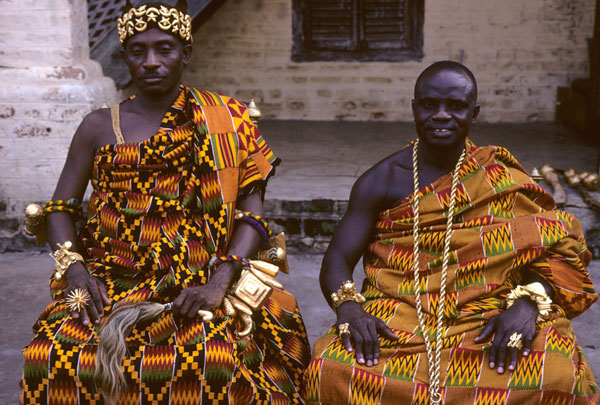
Kente: woven royalty
Originating from Ghana and Togo and brought to Côte d’Ivoire through migrations, kente is a cloth not worn lightly. In Ashanti culture, it is reserved for kings, chiefs and great occasions. Each piece of cloth, each shade, each interlacing has a precise meaning: while gold symbolises prosperity, blue embodies harmony and black expresses spiritual energy.

Behind this meticulous weaving lies a legend: that of the spider Anansé, who is said to have inspired men with the art of weaving by spinning her web with infinite patience. Even today, kente is not content to be a beautiful fabric. It is a declaration of identity, a pride worn like a second skin.
Bogolan: between tradition and mystery

Made of mud and cotton, the bogolan of Mali could be seen as a kind of armour. Once worn by hunters and warriors, it was meant to protect its wearer, linking them to the forces of nature and to the ancestors. Each hand-drawn pattern has a hidden meaning: a stylised animal evokes a protective totem, a zigzag recalls the paths of life. Bogolan is a new skin one slips on to face the world, a talisman charged with memory and power.
Adinkra: messages from the past

In Ghana and Côte d’Ivoire, adinkra is a language in itself. Each pattern printed with vegetable ink carries a message, often a proverb or a life lesson. “Gye Nyame” proclaims the supremacy of God, “Eban” evokes the safety of the home. Once worn at funerals, adinkra allowed the living to address the ancestors, in a silent dialogue made of symbols and colours.
Shweshwe: the heritage of Lesotho

When French missionaries introduced an indigo-dyed cotton fabric to Lesotho, they never suspected it would become a national emblem. Adopted by King Moshoeshoe I, shweshwe became the uniform of Sotho women, with its delicate patterns and its very distinctive feel. Today, it is being reinvented in South African fashion, marrying tradition and modernity in a bold textile dance.
Ukara: the language of the initiated

In the esoteric circles of the Igbo people of Nigeria, ukara represents their common language. Its patterns, drawn from the Nsibidi alphabet, tell stories that only the initiated can decipher. Worn during rituals by the Ekpe secret society, this indigo-dyed cotton cloth is a passport to ancestral knowledge, a key opening the doors of many mysteries.
Ndop: the royal blue of Cameroon

Hand-woven, indigo-dyed and once reserved for the Bamileke and Bamoun sovereigns, Ndop is a sacred cloth. Each pattern carries symbolic weight: the tortoise embodies wisdom, the cross evokes stability and protection. Even though it tends to disappear under the onslaught of industrial textiles, it remains a marker of prestige and belonging, a cloth where the history of Cameroon is written in thread and colour.
Aso-Oke: Yoruba elegance and prestige

In Nigeria, when a Yoruba puts on a garment in Aso-Oke, he does not just choose an outfit, he asserts his status. This hand-made cloth is synonymous with nobility and distinction. “Sanyan“, which is beige, embodies peace and wisdom. “Alaari“, a bright red, symbolises vitality and strength. Each family, each lineage has its own pattern, passed down from generation to generation like a textile coat of arms.
Samakaka: a cry of identity

In Angola, Samakaka is a symbol of resistance and pride. Its fiery red recalls the blood shed for freedom, black evokes the African heritage, and yellow the much-hoped-for abundance. More than a textile, it is a claim, a banner carried with the awareness of those who refuse to forget.
Faso Dan Fani: the cloth of revolution

Popularised by Thomas Sankara in Burkina Faso, Faso Dan Fani is a manifesto in itself.
“Wearing Faso Dan Fani is wearing the history and the economy of our country”, he said. Entirely hand-woven, this cloth embodies economic independence and national identity: in every thread, a promise of freedom.
Kitenge: the cloth of demands

Although it is strongly associated with Kenyan identity, kitenge was originally imported from the Netherlands. Like batik, kitenge also originates from Indonesia, an island country with its own history of acculturation and cultural and linguistic blending. From Kenya to Tanzania, the fabric is nonetheless everywhere. It represents a language, a statement. Some cloths carry proverbs, others display political messages or wishes for happiness. Every woman who ties a kitenge around her waist knows it: she wraps her body in a story, an emotion, a message she chooses to make resonate.
Every African fabric is an open door to a universe where past and present intertwine. These cloths, far more than “fashion objects”, are witnesses of a collective memory, guardians of an invaluable heritage. Wearing them is claiming an identity, perpetuating a tradition and paying tribute to those who, thread by thread, wove the soul of a continent.
Written by Rama BARRY