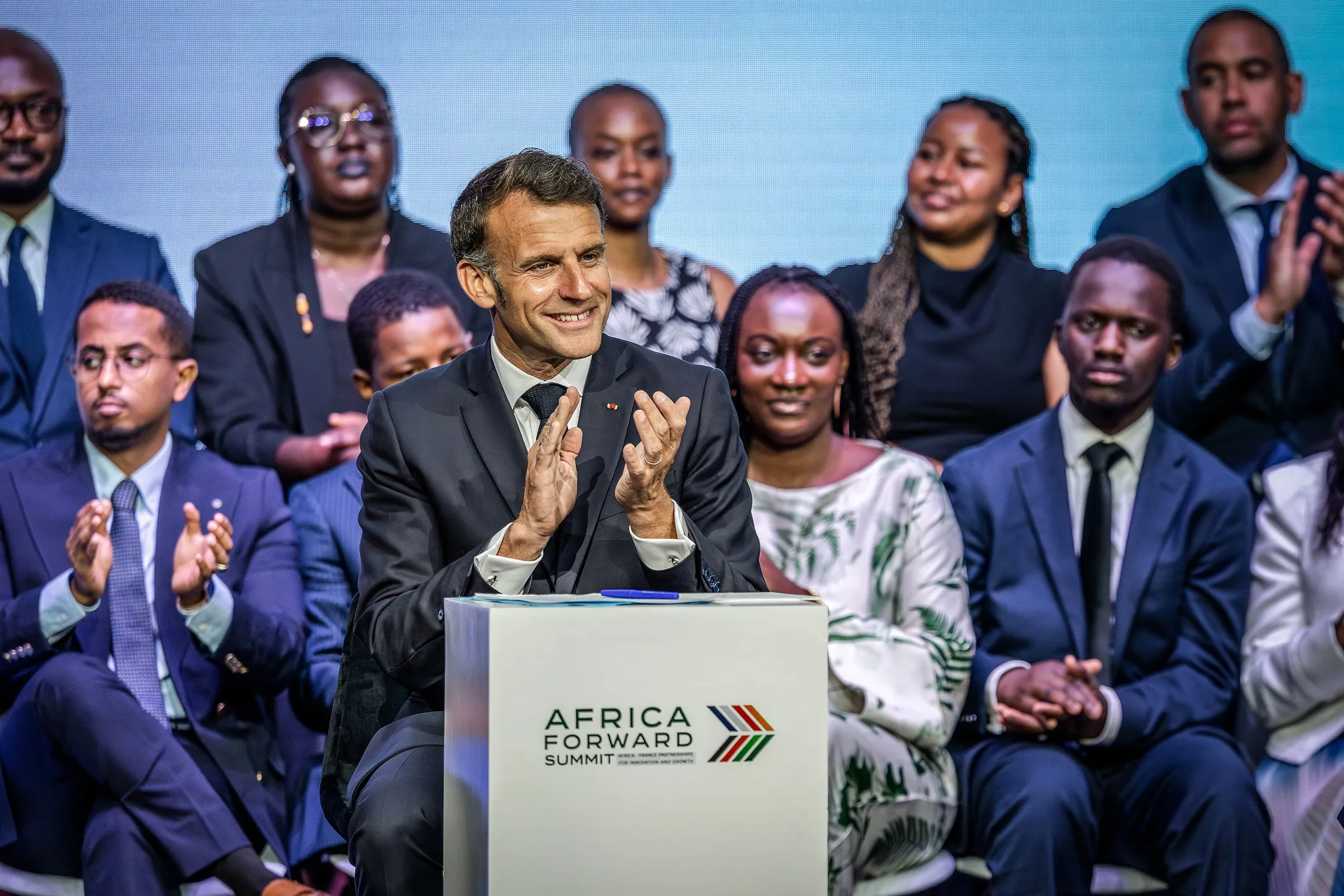
At the Africa Forward summit (11-12 May 2026), Macron proclaims the end of Françafrique; do Africans really believe it?
At the Africa Forward summit held on 11 and 12 May 2026 in Nairobi, Emmanuel Macron uttered a line that immediately crossed borders and set social media ablaze: “We are the true Pan-Africanists.” Delivered at a joint press conference with Kenyan president William Ruto, the statement was met with a mix of astonishment, irony and, for some, outrage.
Behind the rhetorical provocation, one question stands out: nine years after Ouagadougou, what remains of the promises of a break?
THE STAGING OF THE BREAK
The choice of Nairobi is not insignificant. For the first time, a major Franco-African summit is held in an English-speaking country, co-chaired by France and Kenya. The symbolic signal is clear: Paris wants to break with the image of a France confined to its French-speaking backyard, speaking to its former colonies as to vassals. Macron said it bluntly: “I no longer want France to look at Africa as a backyard, where companies would have all the rights or guaranteed contracts. That is over. Since 2017, that era has ended.”

On the Sahel, he adopts a posture of assumed resignation, almost relieved: “You no longer want France to fight terrorism? Very well, we take note.” A sentence that formally endorses what the facts had already imposed, the French military withdrawal from Mali, Burkina Faso and Niger, three member states of the Alliance of Sahel States whose absence from the Africa Forward summit summed up the state of relations on its own. In a few years, France has lost its military bases, strategic industrial contracts and a good part of its image as a stabilising power.
To compensate, the economic announcements were calibrated to impress: 23 billion euros of investments, including 14 billion of French public and private funds and 9 billion African, directed to the energy transition, agriculture and artificial intelligence. The flagship deal remains that of CMA CGM, the world’s third-largest shipping company, which formalised 700 million euros for the modernisation of the Mombasa terminal, a massive investment in a sector where Chinese competition has been head-on for a decade. A Franco-Kenyan agreement on civil nuclear power was also signed on the sidelines of the summit.
THE MICROPHONE INCIDENT, OR THE INVOLUNTARY METAPHOR
But it was an unscripted sequence that dominated conversations online and on the continent. During a session devoted to culture and youth at the University of Nairobi, Macron suddenly stood up, climbed on stage and took the microphone from the hands of a speaker still in the middle of her talk. “Already? Aren’t you waiting for your turn?”, she said to him, stunned.

The scene, widely relayed, crystallised a symbolic reading that many were only waiting for a pretext to voice. The reaction of a Senegalese student, reported by the Associated Press, went viral: “Imagine what would happen if an African leader did the same thing in America or Europe. He behaved like a schoolteacher scolding children.” In France, La France Insoumise MP Danièle Obono was more direct on X: “It’s stronger than him: as soon as he sets foot on the African continent, he can’t help behaving like a colonizer.”
There is something revealing in this gap between the carefully built discourse, the break, respect, partnership between equals, and this unthinking, instinctive gesture that cuts off an African woman in front of an audience of young Kenyans. Pan-Africanism is not a podium posture. It is also read in gestures.
PAN-AFRICANISM, WHO DOES THE WORD BELONG TO?
We must take Macron’s line seriously, not to endorse it, but to understand what it reveals about the French repositioning strategy. By appropriating the vocabulary of Pan-Africanism, Paris is trying to short-circuit the sovereigntist critique rising from the Sahel to the European diasporas. The implicit message: France is no longer the obstacle to African unity, it is now an actor in it.
But Pan-Africanism, from Kwame Nkrumah to Thomas Sankara, from Cheikh Anta Diop to contemporary intellectuals, has always been, fundamentally, a project of self-determination. It cannot be delegated to an outside power, whatever the sincerity of its stated intentions.
Let us not be mistaken. What France puts forward as partnerships mostly corresponds to positioning strategies in a space where it is no longer dominant.

The 23 billion announced in Nairobi are not only outgoing flows: they open markets to French companies in key sectors such as energy, infrastructure, artificial intelligence and port logistics. The agreement with CMA CGM on the port of Mombasa, for example, is not philanthropy but a strategic anchoring on a major trade route, facing international competition that is already well established.
Then there is a question of influence. As mentioned above, France has lost ground in the Sahel and sees its image contested in several African countries, and these investments also serve to maintain a political and economic presence on the continent. They allow it to stay in the diplomatic game, even as the military presence recedes.
Finally there is a question of narrative. By presenting itself as a massive investment partner, France is seeking to take back control of the story of its relationship with Africa, to recast a history marked by Françafrique as “balanced cooperation”. The use of the vocabulary of development, of restitutions or even of Pan-Africanism is part of this symbolic reconfiguration.
It is a combination of market access, maintenance of influence and control of the narrative that the French state sought to put in place in Nairobi. But this strategy remains fragile, because it depends on the ability of African states to accept, or themselves redefine, these conditions of partnership.
Will the 23 billion euros announced in Nairobi create the 250,000 jobs promised, and above all under what conditions of skills transfer and technological sovereignty?
The real question is not whether Macron is sincere. It is whether Africa is in a position to impose its conditions or whether it remains forced to adapt to those of others.
SOURCES
- Macron à Nairobi : « Nous sommes les vrais panafricanistes » – https://visionguin.com/macron-a-nairobi-nous-sommes-les-vrais-panafricanistes/2026-05-12
- Africa Forward Summit : CMA CGM signs $700m Mombasa port deal2026-05-12
- France promulgue une loi-cadre sur les restitutions des œuvres africaines2026-05-10
- Restitutions : « La France a à peu près 90 000 objets dans sa collection publique » – Sally Alassane Thiam, Afrique Patrimoine2026-05-13
- Macron microphone incident at Nairobi university sparks backlash across Africa2026-05-12
- Danièle Obono sur X — réaction à l’incident du microphone – https://x.com/Obono_Daniele2026-05-12