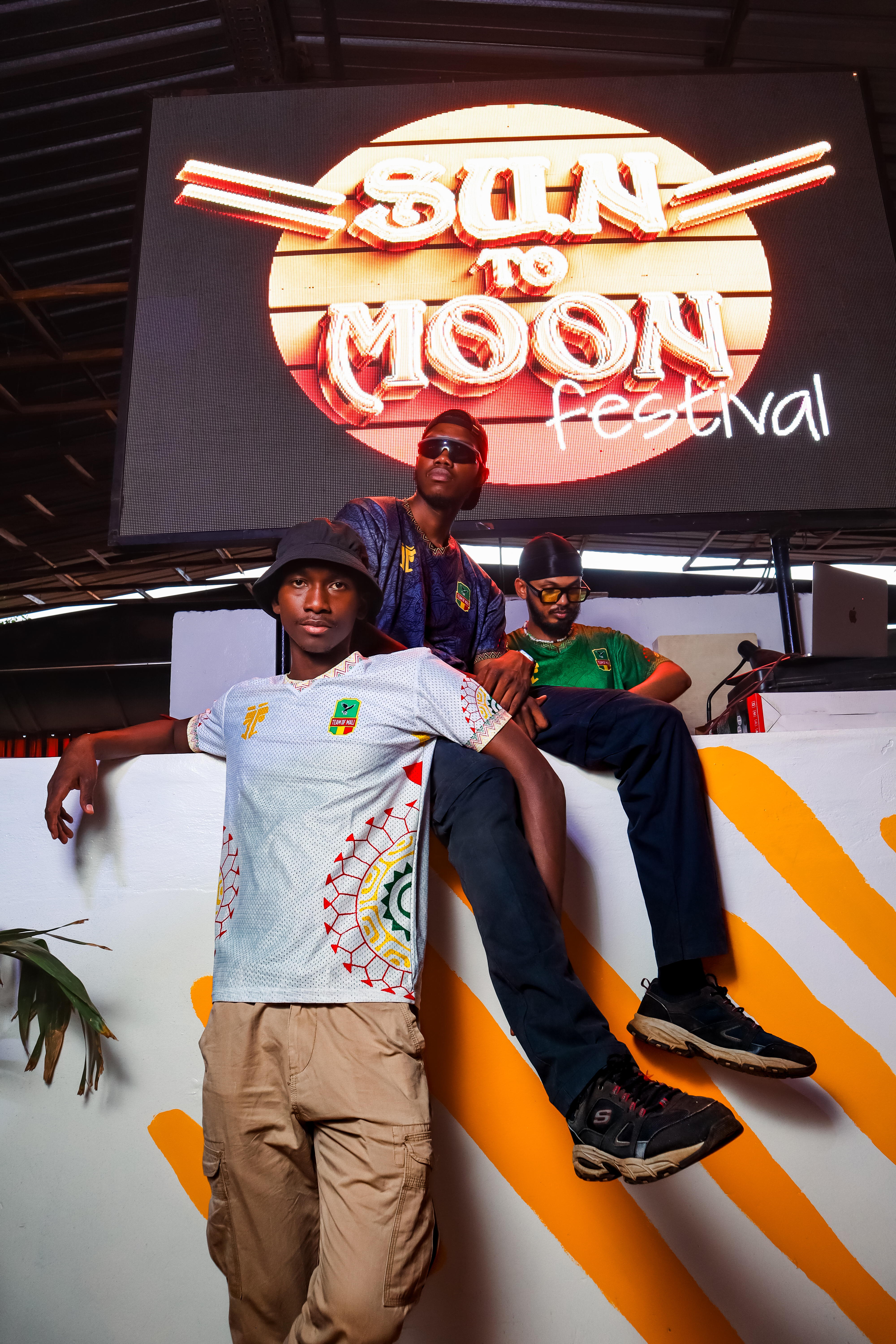
Pierre Konaté (Suntomoon): “Mali’s image had to travel a little further”
From his Bamako neighbourhood to Marrakech for the 2025 AFCON, the founder of the Suntomoon Festival and Yiiri Creative builds, festival after festival, bridges between contemporary African scenes.
Yiiri Creative interview · May 2026 · 9 min read

Four years ago, the Suntomoon Festival was born in Bamako from a simple intuition: bring people together rather than just programme them. This winter, the festival took a plane for the first time, bound for Marrakech, for the 2025 AFCON. For a month, Dada Marrakech hosted the exhibition “La Traversée” and DJ sets. We met Pierre Konaté, Piko to his friends, the man behind the project.
From a Bamako neighbourhood to Suntomoon
Pierre Konaté learned event organising by following the older guys in his Bamako neighbourhood, who had been putting on concerts since he was a child. But very soon, the idea of a different format took hold.
“I wanted to create my own little thing. Something that wouldn’t just be limited to inviting people to come and perform for an evening and then leave, but rather to bring the guys together around something, to show everyone’s talent. You can invite a graphic designer, an artist who’ll freestyle, a DJ friend. I think that’s how Suntomoon came about.”— Pierre Konaté
The first festival took place in July 2021. The name, Sun to Moon, is not just a poetic phrase: it is a format. At the time, in Bamako, you didn’t go into a club before 2 a.m. Suntomoon went the other way and reached an audience that wanted to go out without spending the whole night. “We start when the sun goes down, until midnight, 1 a.m.”

From Suntomoon to Yiiri Creative: widening the scope
The festival grew, and with it the need for a larger structure. Pierre then created Yiiri Creative, a Malian curatorial platform that hosts the festival but also supports other artists and other formats.
“Yiiri has always existed in me. Suntomoon, the team is more about the festival. But we’ve reached a point where we have to try to touch everything, not only music. Yiiri is the platform that carries the festival, but it’s also the promotion of Malian art and culture in the broader sense.”— Pierre Konaté
Why Marrakech?
The festival was originally meant to travel for the 2023 AFCON in Côte d’Ivoire. Ironically, Pierre was in Morocco at the time. He observed, listened, and fell in love with Marrakech.
“The choice of Marrakech, I can say it’s a personal choice. I felt as if I were at home. There’s a resemblance between Marrakech and some towns in Mali, especially in the people. By trying to understand these links, by learning about the relations that have existed and continue to exist between Mali and Morocco, my choice landed there.”— Pierre Konaté
A curatorial intuition, a déjà-vu to dig into, on which the whole special AFCON edition is built.

“La Traversée”, the centrepiece
In Mali, Suntomoon rests mainly on music. In Marrakech, the festival shifts its centre of gravity: the exhibition “La Traversée” becomes the heart of the project.
“We said: let’s really put in something much more solid that will create this dialogue. This exhibition is a space of dialogue between the artists and the people who passed through Marrakech during the AFCON. A space where we discussed individual and collective stories. A lot of it was about Africa.”— Pierre Konaté
Curated by Cheick Diallo — a major figure of contemporary African design, who designed the exhibition’s immersive scenography and is himself among the exhibitors — La Traversée brings together notably Hafida Zizi, Ibrahim Bemba Kébé, Mamadou Thienta, Nybé Ponzio, Cheick Diallo and Smaïl Kanouté, whose performance Chief Scout – 2023 / Black Indians, presented in dialogue with a gnawa maâlem, opened the preview on 26 December. The evening continued with the screening of the Mali–Morocco match — which ended in a draw, a deliberate symbol of a moment of fraternity — and then an afterparty hosted by the collective SoundSisters.


Le 18 and SoundSisters: the go-betweens
In Marrakech, two structures were decisive: the cultural space Le 18, in the medina, and the collective SoundSisters Morocco. Pierre describes them with a Bambara word that says it all: jatigi, the host, the go-between.
“Le 18 was truly our jatigi. They welcomed the project and helped us build it. But before Le 18, there were discussions with SoundSisters. They are the ones who led us there. Thank you to Maria and Balkis.”— Pierre Konaté
He insists on the nature of the meeting with the Moroccan women’s collective, which works for the place of women in the electronic scene:
“We’re not the ones who put them in the spotlight. They didn’t wait to do things well. On the contrary, they’re the ones who invited us.”— Pierre Konaté
A Mali without borders
In selecting artists, Pierre rejects the Mali / diaspora binary.
“When we say Mali, we’re not going to limit ourselves to those who are from the country. We also look at the diaspora. We shouldn’t stick too much to Mali-Mali — we have to go and see the Malians who are in Brazil, in Asia, everywhere.”— Pierre Konaté
A plural vision that repositions Mali as a broadened cultural space rather than a national territory. Blokys Touré (DJ) and Moriba (état de la culture) have appeared on Suntomoon stages during their stays in Bamako — the Moroccan encounter is not a starting point, it is the continuation of a dialogue already under way.
Art and football, the same family
Should cultural events systematically be tied to the big African sports competitions? For Pierre, it is self-evident.
“If you ask me, I’d put football inside a part of art. There are many footballers who are called artists in their own right — the Ronaldinhos, the Messis. We absolutely must have this kind of event, because outside the pitch, you need a space where everyone can meet. Not the rivalry you see on the pitch, but moments to share.”— Pierre Konaté
On the creative side, the team has already collaborated with Team Mali, a jersey brand that mixes football and Malian visual identity — a concrete bridge between the two worlds.

Corispass, building your own tools
Another, more discreet building block of the project: Corispass, the ticketing platform developed by the team.
“Often, we don’t come to find solutions, we create them. There’s no solution in the ecosystem. Ever since I was little, I helped brothers organise concerts, and the problem is always the same: how do you get access? So we created Corispass. We use it for our events, and if others need it, we let them use it.”— Pierre Konaté
The platform has already served major events in Bamako, including concerts by Aya Nakamura, Didi B and Himra.
And next? Paris, Dakar, and a space in Bamako
Marrakech was only a stage. Pierre is looking toward Paris — many Malians there follow the festival — but also Dakar, Abidjan, and a return to Morocco. In the longer term, Yiiri Creative aims to open a permanent space in Bamako: a place for creation, residency and transmission.
“We really want to have our creative space for the festival, but also for lots of other things. A place to try to pass on, to the new generation, what we know — and what we don’t know, but others do.”— Pierre Konaté

The message
“I hope the people who came understood the message behind this festival: trying to talk with everyone, to build bridges between us who are in Africa and those who have left. No barriers with our brothers and sisters all over the world. If at least one or two people tell me ‘We got that’, I tell myself: mission accomplished.”— Pierre Konaté
A crossing, then, in every sense of the word.
Interview by Modibo Touré for HIDA.
Photographs: Suntomoon©.
With thanks to Pierre Konaté, Cheick Diallo, Le 18 Marrakech and SoundSisters.