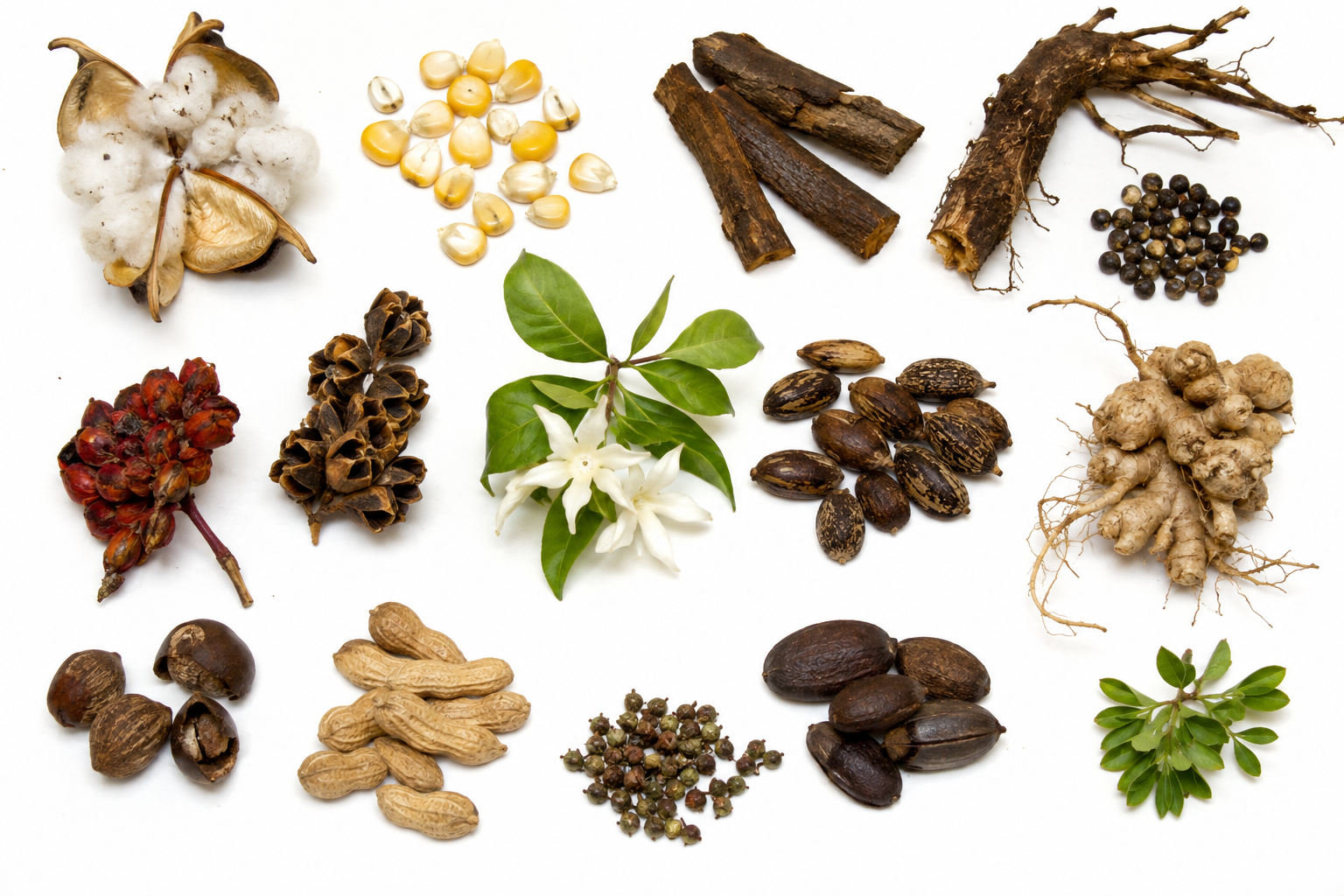
80 to 90% of the seeds planted on the African continent are still produced, selected and exchanged by farmers themselves. An ancestral, reproducible and free system, but one that is now under threat.
Indeed, this is precisely the model targeted by the major initiatives backed by the United States and the Bill & Melinda Gates Foundation, which push high-yield hybrid and GMO seeds that are sterile or non-reproducible, forcing farmers to buy them again every season.

Recent developments
Kenya has just ended a ten-year moratorium on GMOs at the end of 2022, Senegal authorised their commercialisation in 2022, Nigeria became the second African country to accept GMO maize, and Ghana has approved fourteen new GMO varieties of maize and soybean.
On 18 August, Donald Trump announced the acceleration of the development of ibogaine as a treatment in the United States. This psychoactive substance is found only in iboga, an African plant traditionally used in religious ceremonies.
The threat no longer concerns only food, but also medicinal plants.

An alarming situation since the early 2000s
- AGRA (Alliance for a Green Revolution in Africa), founded in 2006 by the Gates and Rockefeller foundations, has built up an entire chain of hybrid seeds and inputs (fertilisers, pesticides) across the continent.
- Alliance for Science, funded to the tune of 10 million dollars by the Gates Foundation, actively promotes GMOs to African publics and governments.
- CGIAR, an international network of agricultural research centres, has received more than 720 million dollars from the Gates Foundation since 2003 to spread these improved seeds through its local networks.
- Historically, USAID also backed this kind of programme — support that is now weakened by American budget cuts, which has led Gates to occupy more of the ground.
For farmers, this could mean the end of seed autonomy.

The traditional farming system relies on reproducible seeds: part of the harvest is kept to sow the following year, seeds are exchanged and selected over generations. GMO and hybrid seeds break this cycle. Protected by patents that forbid their reproduction, they turn the farmer into a captive customer who must buy again each season. If they cannot pay, they do not sow.
Debt.
GMO seeds are significantly more expensive, and transgenic plants often demand more inputs (fertilisers, pesticides).
When a drought or a poor harvest strikes, the farmer is left with a loan to repay and nothing to sell. The case of Bt cotton in Burkina Faso is emblematic: the country bet on this Monsanto GMO cotton from 2008 to 2016, before giving it up because of poor performance and the degraded quality of the raw material. A lost bet after eight years of dependence.
Land dispossession.
The shift to intensive monoculture favours large farms at the expense of small plots.
The risk, according to several experts, is to create “landless peasants” reduced to the status of mere farm labourers.
An executive of a Burkinabè cotton company even announced bluntly that “capable people” would come to farm vast areas of land in their place.
Loss of cultivated biodiversity.
The spread of GMO monocultures reduces the genetic heritage and ultimately threatens the disappearance of farmers’ seeds
varieties selected over centuries to adapt precisely to a local soil, climate and rainfall.
Cross-contamination.
Pollen from GMO crops can contaminate neighbouring fields, endangering the native seeds that farmers have developed and refined over centuries.
Worse, farmers whose fields end up contaminated could even have to pay royalties to the firms holding the patents on the genes found in their crops, a situation already documented in the United States and Canada.
Breaking a virtuous model.
African peasant farming traditionally combines several crops and livestock on small plots: a system very favourable to the environment, biodiversity and soil health. GMO monoculture takes a diametrically opposite path.
Dependence on fossil fuels and soil degradation.
By relying on petrochemical inputs, this agricultural model degrades soils and increases dependence on fossil fuels, while depriving farmers of a food safety net (crop diversity) when drought strikes a single crop such as maize.

In sum, the central criticism fits in one sentence: “Whoever controls the seed controls hunger.” What worries peasant movements and NGOs such as GRAIN, AFSA or the Coalition for the Protection of African Genetic Heritage, is not science itself, but the transfer of control over a resource as vital as the seed, from the farmer to the multinationals and the foundations that fund them. In Mali in particular, farmers’ organisations have opposed GMO cotton since 2009.

Suzannah Mirghani also tackles this issue in her film “Cotton Queen” released in 2025, in which traditional Sudanese cotton is gradually replaced by sterile seeds.