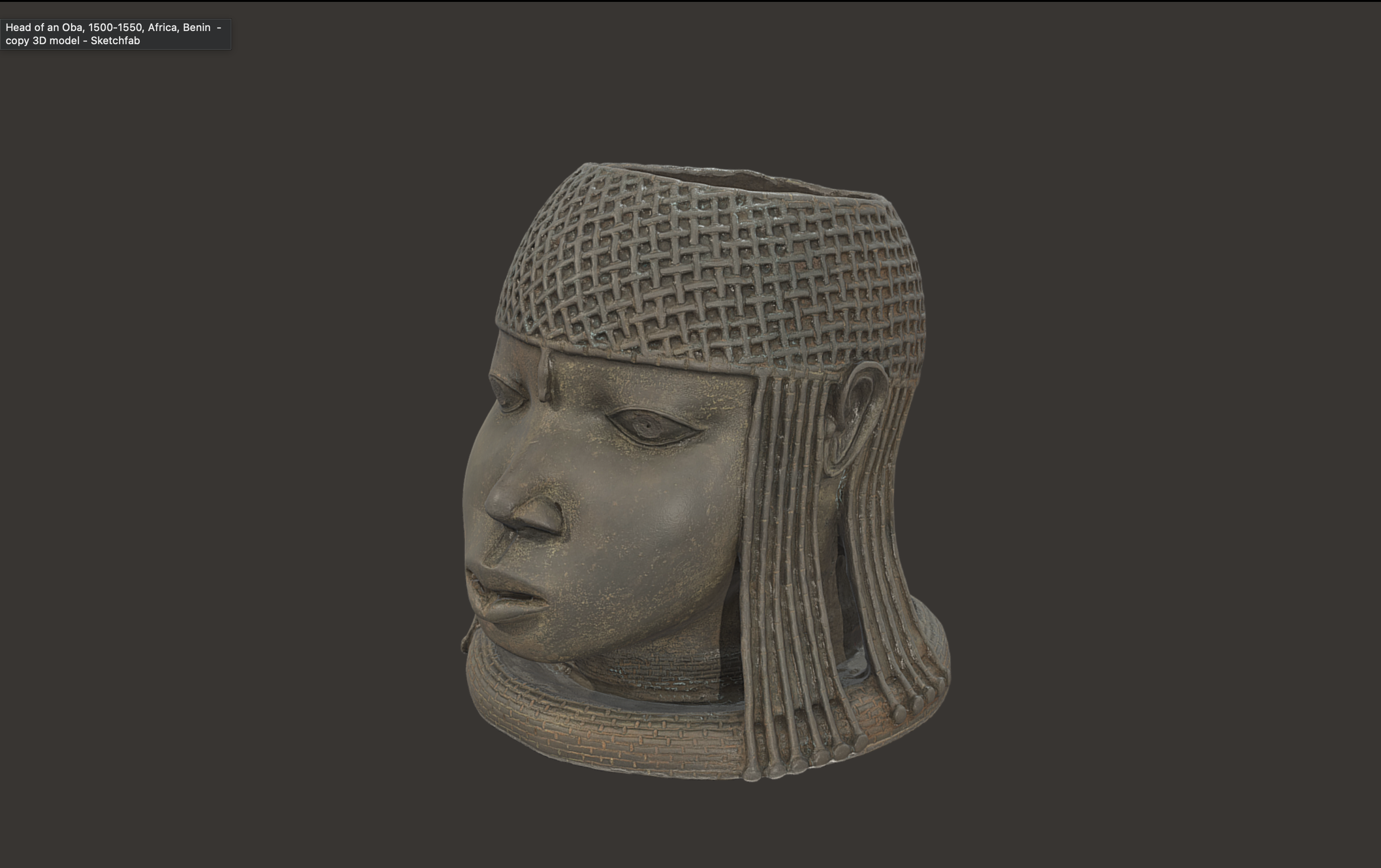
Dozens of institutions are scanning sacred African objects and releasing the 3D models in open access: a new form of extraction already being called “digital neocolonialism”.
Dozens of institutions are scanning sacred African objects and releasing the 3D models in open access: a new form of extraction already being called “digital neocolonialism”.
At the Musée du quai Branly in Paris, the empty space left by the Djidji Ayokwê, a wooden talking drum returned to Côte d’Ivoire, has become a symbol in spite of itself. Not a symbol of victory, but of the road still ahead. For while the debate over physical restitution occupies chancelleries and advocacy groups, another form of appropriation has quietly settled into the corridors of European museums: the 3D digitisation of African collections, released in open access on the internet without the communities of origin having been consulted, informed or, above all, having consented.
Physical restitution is blocked, digital restitution is presented as the solution.
In Great Britain, the *British Museum Act* of 1963 and a 2023 court ruling reaffirmed in black and white that the trustees of the British Museum have no legal power to part with objects for the sole purpose of returning them. This well-documented institutional resistance has paradoxically opened a rhetorical way out for museums: digitisation as an acceptable substitute, as a gesture of openness, as progressive modernity. “We can’t give you back the object, but we can share a copy of it with you.” This shift is precisely what researchers, museum professionals and community representatives have been criticising for several years.

The “Scan the World” initiative gives a measure of the scale of the phenomenon. This non-profit platform has digitised more than 18,000 sculptures, monuments and artefacts from museums and public spaces around the world. The files are in open access, downloadable by anyone.
The stated intention is laudable: to democratise access to world heritage. But “world” does not mean “fair”. The African objects featured there have often already crossed a first border without consent during their colonial collection. They cross a second one when they are digitised. The logic of extraction has not moved.
When meaning is stripped away.
The deepest criticism is not only legal. It is epistemological.
“Once an object is separated from its meaning, it takes on a different life. And that is where appropriation can begin,” sums up a museum professional in current discussions on the ethics of digital heritage.
A Yoruba ceremonial mask or an Akan talking drum is not a neutral artefact. It carries protocols of access, spiritual hierarchies and prohibitions. To digitise it is first of all to ignore that these protocols exist and that they apply precisely to anyone who can see, touch or reproduce the object.
Researchers at the University of the Witwatersrand in Johannesburg were among the first to raise the question head-on when digitising the sacred site of Ga-Mohana Hill, in South Africa. Their approach has become a textbook case: before publishing the 3D model, they created a contextualisation site that explicitly warns people who may not wish to view the model for cultural reasons or because of its ritual significance. It is not a perfect solution. It is, at least, an honest attempt to acknowledge that technology does not come with built-in ethics.
This approach remains the exception. The rule, in European institutional practice, is the complete absence of free, prior and informed consent, what international law on Indigenous peoples calls FPIC (*Free, Prior and Informed Consent*). The communities whose heritage is held in Western museums benefit from no implementation of appropriate cultural protocols before their objects are scanned, indexed and put online.

To name just a few, several major museums and institutions worldwide already follow this line:
- The Royal Museum for Central Africa (RMCA / Africa Museum): located in Tervuren, Belgium, it offers a vast collection of 3D digital twins and ethnographic models (such as the mbuya masks of the central Pende), accessible on platforms such as Sketchfab and on the Africa Museum website.
- The Lowe Art Museum presents a collection of 3D models including helmets and ceremonial masks, also hosted on Sketchfab.
- The Museum of African Art in Valladolid uses collections of 3D models created in partnership with Global Digital Heritage.
- The Museum of Ethnography in Geneva (MEG) holds important African ethnographic databases and online collections, which can be consulted through its online catalogue.
A legal blind spot that says a lot…
The question of who owns the digital files reveals another layer of the problem. A researcher working on African collections recently described a Kafkaesque situation: the files of the objects he had scanned in a museum do not belong to that museum, but to the university that funded the digitisation.
“If I wanted to send all the files to their community of origin […] I can’t, because I don’t have permission to do so within my own institution.”
Data extracted from African heritage circulates freely in North-Western academic and digital circuits. It feeds databases, research projects and potentially artificial intelligence applications. The communities of origin, meanwhile, have no access, no say and no benefit from these flows. It is a chain of extraction in which each link reproduces the one before.
Data sovereignty: a political response in the making
Faced with this phenomenon, the intellectual and political response that is gaining strength has a name: Indigenous data sovereignty. It emerges from a long reading of colonial history, one that recognises that the extraction of African knowledge, bodies and objects has always preceded or accompanied the extraction of material resources. Whether historical or contemporary, algorithmic or archaeological, the logic remains the same.

African institutions are trying to take back control. For some of them, the digital age has become an essential lever for preserving and sharing cultural heritage on their own terms. But this ambition runs up against considerable infrastructure inequalities in bandwidth, digitisation equipment, storage and archiving capacity that maintain a de facto dependence on North-Western institutions.
The “democratisation” through digital technology promised by European museums looks, from this side, like a conversation whose terms were fixed in advance. African and diasporic communities are asking not for improved access to copies of their own heritage, but for the ability to define for themselves what can be shared, with whom, in what context and in what form.
What non-consensual digitisation systematically bypasses is precisely this agency. Technology itself is neither good nor bad. The question now is who controls it, and whose benefit it works for.
The coming debates around international heritage law could, at last, bring the digital dimension into the negotiations. Several African delegations at UNESCO have begun to ask for this explicitly. If the void left by Djidji Ayokwê at quai Branly embodies a promise, it remains to be seen whether that promise will survive the move onto servers.
SOURCES
- “Scan the World” digitises 18,000+ objects in open access – myminifactory.com
- British Museum Act 1963 and 2023 court ruling on restitution – www.theguardian.com
- Ga-Mohana Hill: ethical digitisation of a sacred site, University of the Witwatersrand – theconversation.com
- Debate on colonial digitisation and Indigenous data sovereignty – aljazeera.com
- Djidji Ayokwê and restitution at quai Branly – lemonde.fr/afrique/
- Indigenous Data Sovereignty – GIDA (Global Indigenous Data Alliance) – gida-global.org