“Music is the perfect expression of an ideal world that would speak to us through harmony.”
Albert Camus
Throughout history there has never been a people that did not make music. Music and song act as cements around which groups form or solidify. Music and song are generally used to express or provoke emotions, but they also prove useful when it comes to approaching certain societal issues.
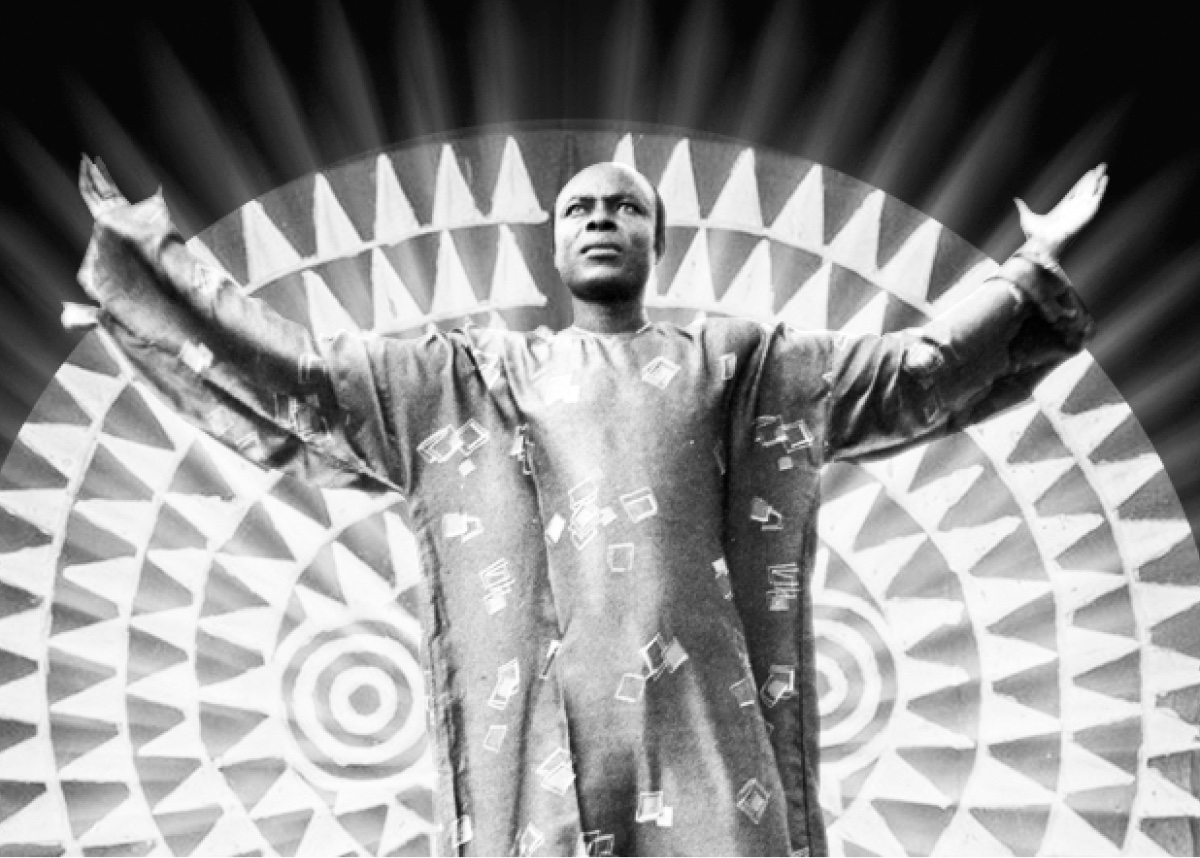
On our tour of the continent, we will stop for a moment in Burkina Faso, formerly Upper Volta, to sketch the features of a famous yet forgotten musician and singer.
Let us waste no more time and dive into the past of the Troubadour of the Savannah, none other than Pierre Sandwidi.

Pierre Sandwidi was born in 1947 in the centre of Upper Volta, in Boulsa. He began learning the guitar at the age of thirteen, the young man earned his baccalauréat a few years later and became a nurse at the Yalgado Ouedraogo hospital in the Voltaic capital: Ouagadougou.
In 1965 his appetite for music led him to become a technician at Radio Haute-Volta. Pierre took the opportunity to polish his guitar repertoire. Indeed, songs were broadcast on national radio and recorded live. A godsend for the “budding stars”, the nickname given to new Voltaic musical talents, of whom our troubadour was one.
Later, the musician in the making travelled the length and breadth of the country on behalf of the Institut de Recherches pour le Développement (IRD) where he soaked up the different cultures and traditions, which later fed his experience and his musical repertoire.
On his return to the capital, Pierre joined a trade union while pursuing his efforts and learning in music.

In the logical course of the 1960s he joined the National Ballet of Upper Volta, modelled on the Guinean ballets of Sékou Touré, and made several trips. Pierre was a guitarist there and performed in Niger, Côte d’Ivoire, Benin and also in Canada in 1973.
Back in Upper Volta, a new chapter of his life opened as he met Idrissa Koné, a cultural entrepreneur who had two production houses and radio stations under his wing. The two men met in Bobo-Dioulasso, a city in the south of the country.
As they got on well, Pierre agreed to record a track with Idrissa Koné, which became the song called Lucie. This love song was composed with “Franco-Mandinka” lyrics mixed with French and Afro-Cuban airs. The label Disques Paysans Noirs sponsored the track.
Pierre Sandwidi resigned from the IRD to devote himself to music, which allowed him to record two 45 rpm records in 1975. He repeated the feat the following year by recording three new 45s. He also recorded Marietou in the 1970s. This song is considered a perfect example of callao. The callao is a type of dance launched by Pierre Sandwidi himself, inspired by the movements of a Sahelian bird of the same name.

Pierre Sandwidi stands out, like Farka Touré, because he tackles the social and societal problems of his country. His songs satirising the rural exodus to the country’s big cities earned him a reputation as a committed artist. In 1977, he released Yamb ney capitale (The capital is yours), considered one of his finest songs. The record sold almost 3,000 copies, a record in the country.
Still socially committed, he returned to Abidjan to record his first album, again focused on the problems suffered by Upper Volta.
During the Sankarist revolution from 1983 to 1987, the troubadour became more involved in politics as a militant of one of the Committees for the Defence of the Revolution (CDR). This allowed him to organise cultural activities in his neighbourhood.
However, upon the death of Thomas Sankara, a cult figure of the late 20th century whose portrait Histoires d’Afrique has already drawn for you in a previous article, Sandwidi left the political scene. He then devoted himself to writing plays and composing songs. His last came out in 1995, three years before his death.

The troubadour of the savannah did not survive his illness and died in 1998 at the age of 51. Thus ended the destiny of a man apart, who marked the generations of his time through his political and social commitment but above all through his music.
Although posterity is hard to obtain, good things come to those who wait, since after being forgotten for many years, Pierre Sandwidi was rehabilitated for the last time in 2021 alongside the greatest, such as Amadou Balaké and Abdoulaye Cissé.
Sources:
- – Pan African Music: https://pan-african-music.com/pierre-sandwidi-le-troubadour-de-la-savane/
- – Radio Nova: https://www.nova.fr/news/pierre-sandwidi-dans-les-70s-le-son-du-burkina-faso-19937-14-05-2018/