and it left us hungry for more.
I am a Franco-Moroccan tattoo artist and psychoanalyst. For ten years I have worked on preserving and passing on Amazigh tattooing as a North African cultural and spiritual resource.
It was with enthusiasm that I put my card to work and crossed France just to see this exhibition on my culture, held at the Mucem in Marseille.
I found myself facing the – very beautiful – colonial leftovers. Like many Amazigh people and activists, I came out frustrated and angry.
A rich culture, a poor exhibition
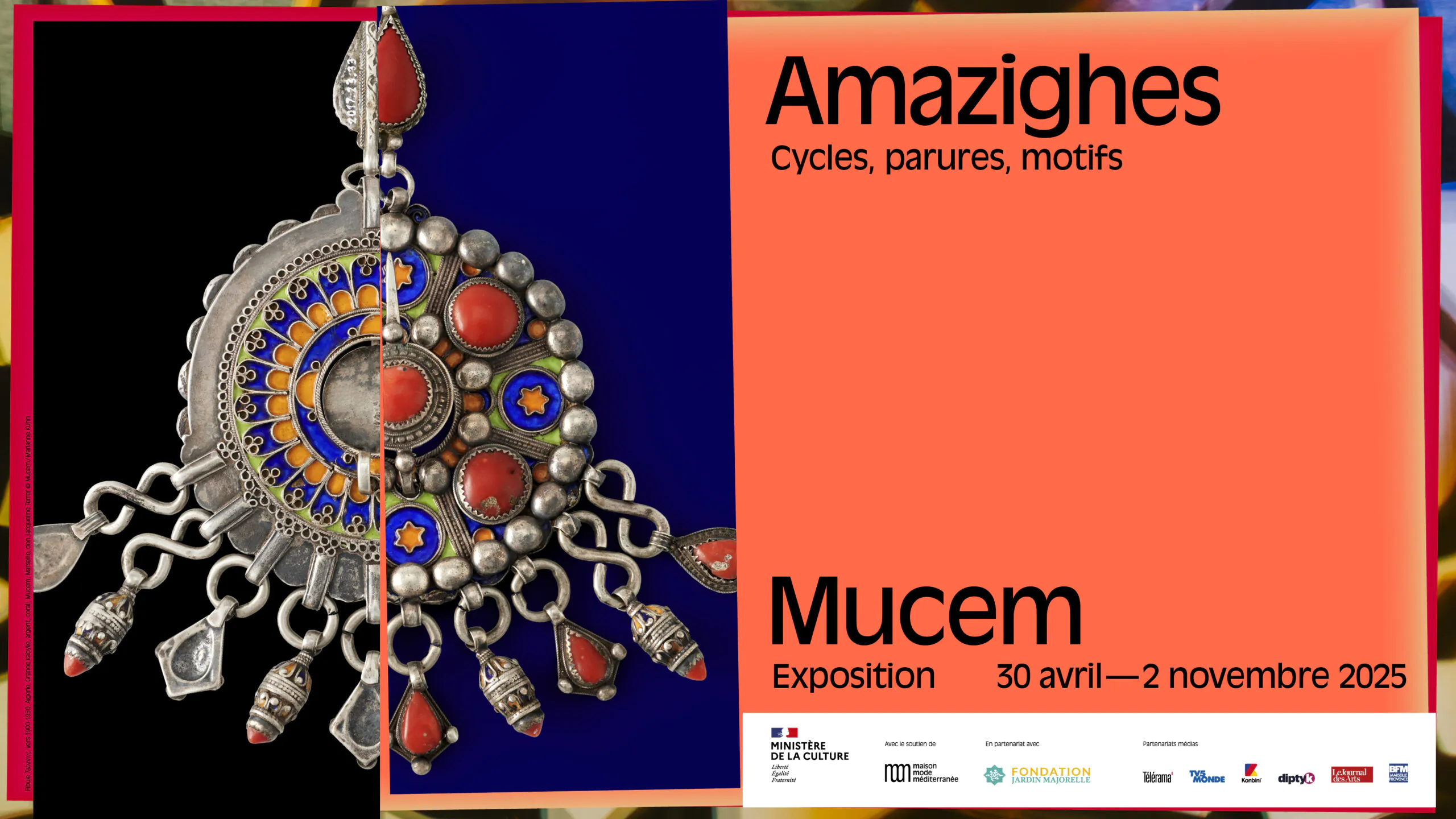
The Mucem exhibition “Amazighes. Cycles, parures, motifs” has just come to an end, and it left us hungry for more.
Heavily publicised, the proposal sounds good, with the term Amazighes put in the feminine to honour women, the great craftswomen of our heritage. We appreciate that the museum sets aside the exonym Berber and uses Tifinagh, the Amazigh alphabet, throughout the exhibition. The entrance puts stars in your eyes with a very beautiful map of Africa that lets you visualise the extent of Tamazgha: the Amazigh geographical and linguistic area. On one side we enjoy a contemporary piece by Amina Ageznay, on the other an ancient ceramic from the Canary Islands. The perspective offered between modernity and antiquity is dreamy, but narrows as the exhibition goes on. You leave with a colonial aftertaste despite a laudable attempt to change the museum paradigm.
The persistence of Eurocentrism
It is very welcome that one of the two curators is North African, but why is the exhibition not entirely entrusted to people from the culture?
In two places, right next to craft pieces, books on Moroccan culture written by French people are on display. Once again we receive the message that Indigenous authors are not enough on their own to present our cultures. One could see progress in a form of narrative hybridisation carried by both the descendants of colonisers and of the colonised… but no. How long will we still have to fight for our African voices to be carried in institutions by ourselves, without white validation?
The exhibition’s museum insularity reflects a Eurocentrism in the continuity of colonial empires. Where do these Indigenous art pieces, supposed to represent a cultural territory covering almost a quarter of Africa, come from?
Overwhelmingly from the Pierre Berger museum and the scientific society of the Canary Islands museum, a territory that is administratively no longer Amazigh but Spanish.
The event gives the impression of the result of cronyism between European museums, easy and quick.
The lack of scientific rigour taints the visit. Going to a museum dedicated to Mediterranean cultures, I expect to see the fruit of rigorous anthropological research reflecting the diversity of Amazigh culture… and well, not at all. How can one omit the crafts of Libya, of the Siwa oasis in Egypt, of Mauritania, Mali, Burkina Faso, Niger, or confuse henna with tattooing? By presenting a majority of pieces from Algeria and Morocco, the exhibition acts as a reflection of the French colonial empire.
As for the texts, besides being poorly written, the information in the panels is partly inaccurate or incomplete. It is as if the beauty of the pieces on display had to be enough in itself, in an exotic power, a distant echo of human zoos.
As always, no space is given to orality, which is nevertheless inseparable from the artistic production of African societies. We are deprived of the voices of the women artists we would like to hear. Again and again, image and writing hold authority. Yet it is through laughter and whispering that meaning and the spiritual force tied to motifs and gestures are transmitted.
Giving meaning by interpreting in a “symbolic” way is in itself Western. To my mind, to symbolise is to distance, whereas in our African cultures, through the sign we come closer and merge with the invisible.
To end the visit I went through the museum shop, thinking I would find other resources echoing the exhibition. Well, almost nothing: on a small piece of furniture you find the exhibition catalogue surrounded by five books on Amazigh culture. No bibliographic research was done to complete the event. There is no Amazigh craft at all, while the museum shop is full of merchandising, made in China?
Count ourselves lucky for so little
How many square metres to present this vast African culture? A space barely larger than the shop. Between pottery, jewellery, weaving, engraving, embroidery, mural painting, tattooing, make-up and henna, the richness of signs and motifs is hard to grasp, yet only one carpet is presented, a few pots, a few drawings of engraved doors, a few adornments, a few photos of tattoos… Clearly we still like Indigenous people very much as long as they do not take up too much space.
Unlike the poorly written label texts, the booklet, mostly written by authors from Tamazgha, is of quality, pleasant and interesting to read. But a two-speed cultural policy obliges: to access deeper content you need time to read and 25 euros to spend.
The museum
“open to the wider world” unfortunately did not go out to meet the Amazigh people of its own Marseille territory. The exhibition created no programming that would have allowed the heirs of our culture to bring it to life and complete it.
It feels like a rather elitist space, while Marseille has a large Amazigh population. Not a single craftswoman from the city was invited to sell her work in the shop. The Mucem, perched above the port, does not seem to go out to meet the people it presents; the pieces shown in display cases are cut off from the life they were born from.
This exhibited craft is an emanation of life, of song, of soiled and worn hands, of creative personalities, of bodies that tell stories as they shape. This proposal left me with an impression of being cut off from the ground.
Once again the other is exhibited more than invited to share themselves on their own terms and codes. The efforts made to leave the exoticising exhibition format are appreciable, but in the end they underline colonial biases that are still very much present.
Ellem Lucas Manganelli
Casablanca, 14 November 2025


