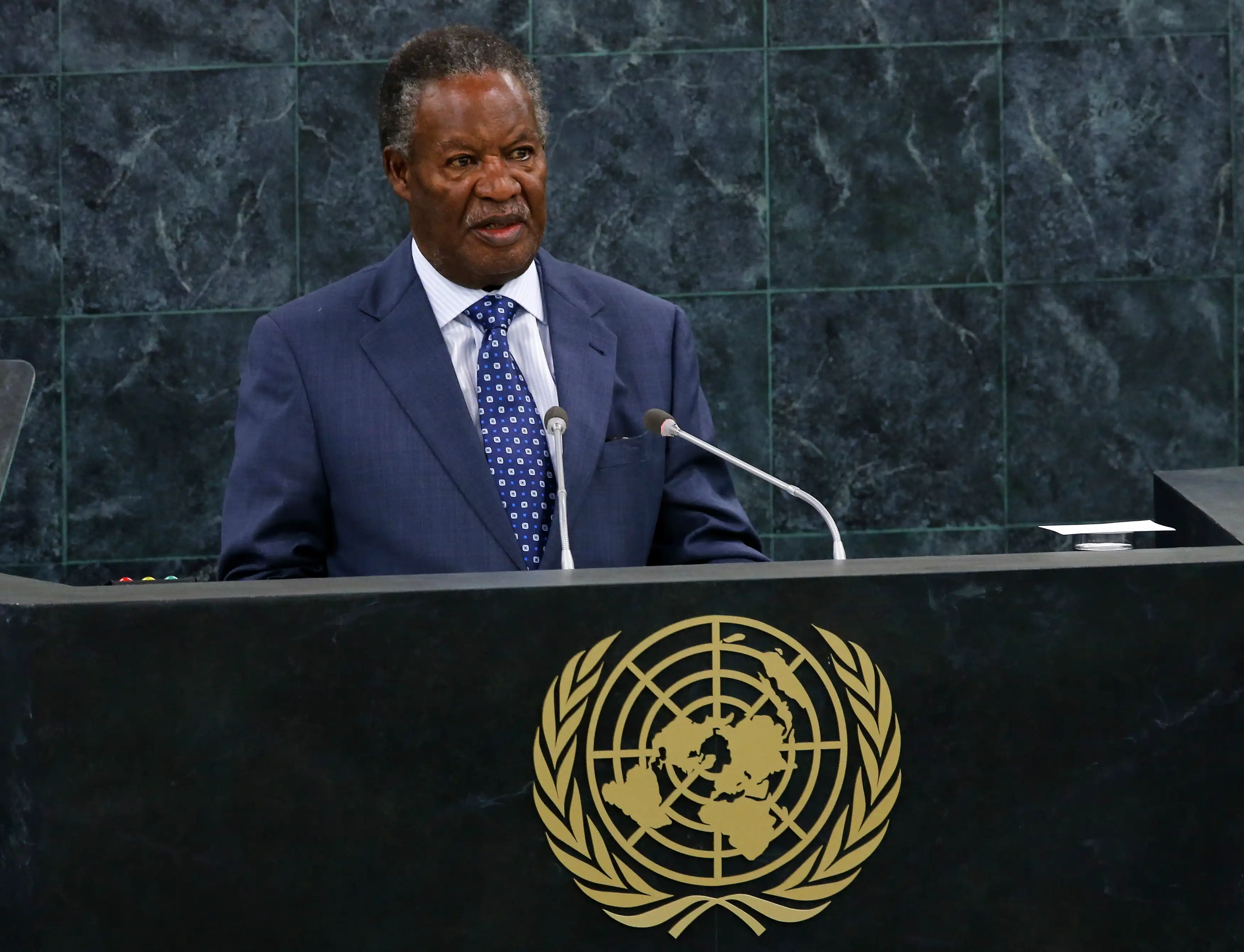
Michael Chilufya Sata was not born into the circles of power. Before becoming president of Zambia, he knew low-paid jobs, manual labour and the British railways. A journey that took him from the platforms of Victoria station in London to the presidential palace in Lusaka.
Sata’s story is one of an extraordinary social and political ascent. But it is also the story of a man who, once at the top, found himself confronted with the contradictions of the power he had spent years fighting to win.

The Victoria station porter
Born on 6 July 1937 in Mpika, in what was then Northern Rhodesia, Michael Sata began his working life far from presidential palaces. He first worked in the police force, then became involved in trade unionism and politics. In the 1970s, he left for the United Kingdom. There he held several jobs, including in a laundry and at the Vauxhall car manufacturer, before joining British Rail.
He started as a porter at London’s Victoria station. He then became a signalman and later a train driver.
This experience would deeply shape his political persona. Sata could present himself as a man who knew the world of work because he came directly from it. He was not the heir of a political dynasty. He was the one who had worked his way up the ranks.
When he returned to Zambia, he gradually entered national politics. He became an MP, then governor of Lusaka. He gained a reputation as an energetic man, particularly visible on infrastructure issues and the management of the capital.
He then became a minister under President Frederick Chiluba. But it was when he moved into opposition that Michael Sata truly became a national political figure.
The ‘King Cobra’ enters the scene
In 2001, Sata founded the Patriotic Front, the PF. He stood in the same year’s presidential election but won only 3.4% of the vote. In 2006, he made considerable progress and came second with nearly 30% of the ballots. In 2008, after the death of President Levy Mwanawasa, he stood again and won around 39%, but lost once more.
Three defeats were not enough to make him disappear.
On the contrary, Sata gradually built his image as a tireless opponent. His outspokenness, his combative temperament and his attacks on the elites earned him the nickname ‘King Cobra’.
His message then rested on one simple idea: Zambia’s wealth must benefit Zambians more.
Promising to give power back to the people
As the 2011 election approached, Sata turned this rhetoric into a political programme.
He promised to fight corruption, create jobs and improve the population’s standard of living. He advocated a better redistribution of the income from copper mining, the country’s main source of wealth.

He also promised free education and a new Constitution within 90 days of coming to power.
His message appealed in particular to parts of the working classes and to workers who felt that the country’s economic growth did not benefit the population enough.
But another target occupied a central place in his campaign: China.
China as a symbol of confiscated sovereignty
In the 2000s, Chinese companies took a considerable place in the Zambian economy, particularly in the mining sector. Sata made this presence a major theme of his opposition. He accused some Chinese companies of exploiting Zambian workers and denounced what he saw as Beijing’s excessive influence over the national economy.
His rhetoric sometimes became particularly virulent. He notably used the term ‘infestors’, a contraction of ‘investors’ and ‘infest’, to describe certain Chinese investors. But this position would change.
From 2008 onwards, Sata said he would protect Chinese investments if he came to power. Once elected, he adopted a far more pragmatic stance: foreign investors were welcome, but they had to respect Zambian workers and the country’s laws.
This shift was one of the first great contradictions of his career: the man who had made challenging Chinese influence an electoral argument now had to reckon with the economic reality of a country heavily dependent on foreign investment and its mining industry.
After ten years, president at last
On 20 September 2011, Michael Sata stood in a presidential election for the fourth time. This time he won with around 43% of the vote, ahead of the incumbent president Rupiah Banda. On 23 September, he was sworn in and became the fifth president of Zambia.

After ten years in opposition, the former Victoria station porter entered State House. The handover was historic: the PF ended twenty years of Movement for Multiparty Democracy dominance.
For his supporters, it was the culmination of an exceptional political story. A man from a working-class background had just conquered the country’s highest office. But it was precisely from that moment that his political narrative became more complex.
Build, decentralise, but not deliver everything
During his three years in power, Sata launched an infrastructure development policy and pursued administrative decentralisation.
In 2011 he created the province of Muchinga and multiplied the number of districts in order to bring the administration closer to the people.

His government also continued investing in infrastructure and tried to strengthen the state’s presence across the regions. But several of his flagship campaign promises remained unfulfilled.
The Constitution he had promised to have adopted within 90 days was not delivered within the announced timeframe. His promises on jobs and free education also led to disappointment.
From 2012 onwards, observers were already noting a president who had not managed to turn all his campaign promises into concrete policies.
The contrast was all the more striking as Sata had built himself precisely on his ability to denounce the shortcomings of previous governments.
From opposition figure to man of power
The other change concerned his relationship with institutions and his opponents. The man who had spent a decade challenging power was now accused by his critics of seeking to restrict the space left to the opposition and to critical voices.
His government was criticised in particular for the pressure exerted on certain opponents and media outlets. The temperament that had been his strength in opposition thus became a source of controversy once he was president.
This transformation is not unique to Sata. It is one of the great contradictions of many political careers: an opposition figure can thrive by challenging power, before having to defend the very institutions and balances they criticised while in opposition.
A president with an extraordinary career
In the end, Michael Sata spent only a little over three years at the head of Zambia. In 2014, his health deteriorated. His absences from public view fuelled questions while his government communicated little about his condition. He eventually travelled to London to receive treatment.

On 28 October 2014, Michael Sata died at the age of 77 in a London hospital. He left behind a career that is difficult to sum up in a single image.
He had been a policeman, trade unionist, manual worker, porter, railwayman, MP, governor, minister, opposition leader and finally president.
He won an election after three presidential defeats and ten years in opposition. He promised to fight corruption, create jobs, redistribute more of the copper revenues, make education free and quickly reform the Constitution.
He also invested in infrastructure and launched a decentralisation policy. But he also left behind unfulfilled promises, a pragmatic U-turn on Chinese investment, controversies over his way of exercising power and, above all, an unfinished mandate…
Michael Sata embodies the possibility, for a man from a working-class background, of climbing every rung of the ladder to reach the highest office. But his career also reminds us that winning power and exercising it are two different battles.
The first, Michael Sata won after ten years. The second, he had only three years to fight.


