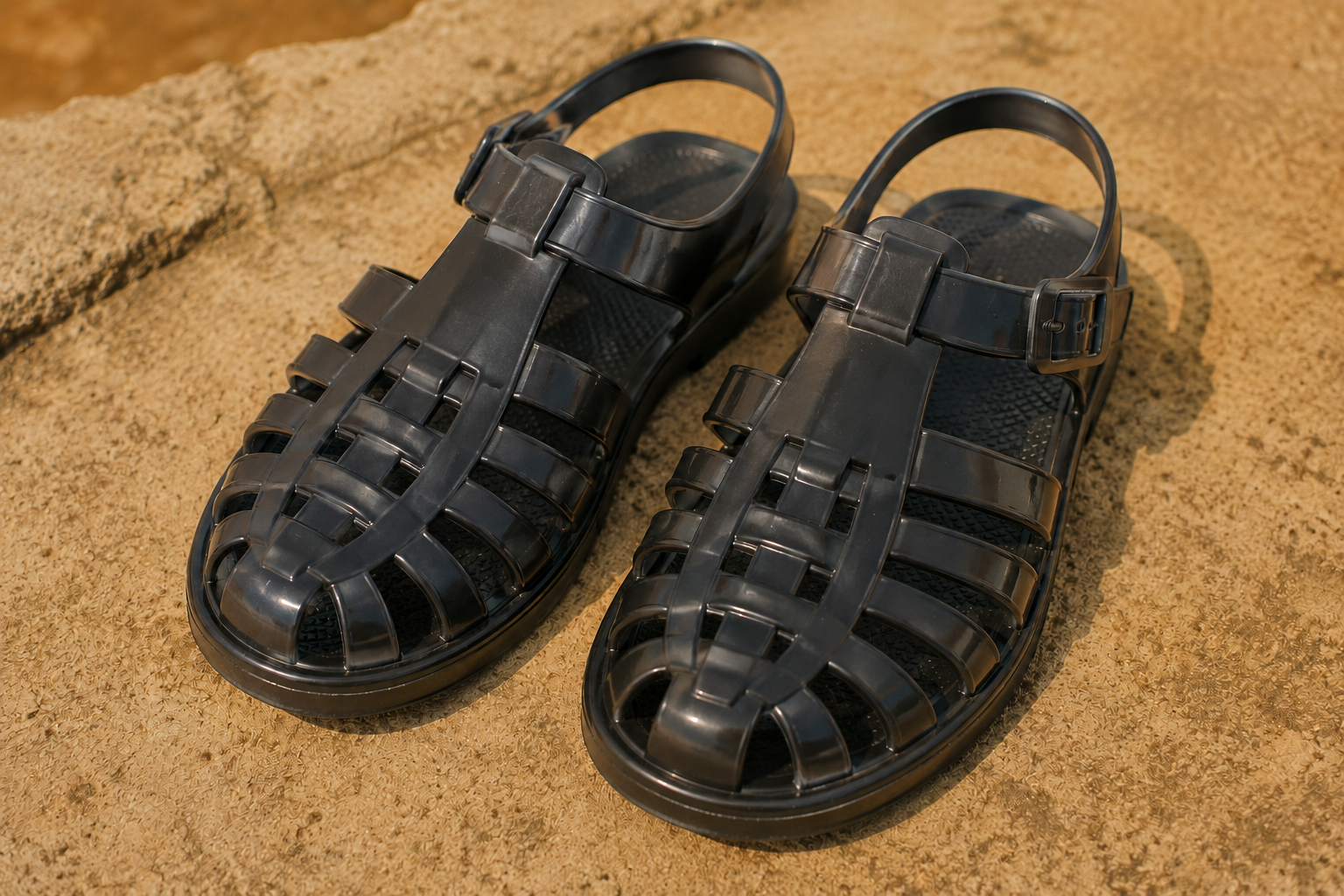
Samba, Lêkê, Mika, Bata or Jelly Shoes: the name you know them by already says a lot about where they are familiar to you. Practical, light, colourful, with a sophisticated simplicity, these plastic sandals have shod several generations of men and women across our territories. In Africa and in the Antilles, their popularity is explained by local uses, practices and habits.
More than a garment, their cultural and social value outweighs their role as an accessory. A pair of plastic sandals awakens images, a setting and emotions in our memories. Yet their origins remain unknown to many of us, as does their industrial and colonial history. Although their production was for a time African, the jellyfish sandal (la méduse) originated far from the continent, in the Puy-de-Dôme.
The origins of the plastic sandal

This is a post-war creation attributed to Jean Dauphant, a cutler from the Auvergne. The first name known for it is the Sarraizienne, before it became more commonly called the méduse. The story goes that Jean Dauphant designed the first sandals from plastic offcuts originally used to make knife handles.
From the Auvergne mountains to the coasts of West Africa
The méduse had mixed success in mainland France, but was exported far more successfully to Africa. In the aftermath of the Second World War, the French colonial empire was still in place. French manufacturers, Jean Dauphant among them, saw in AEF (French Equatorial Africa) and AOF (French West Africa) a natural outlet.
The plastic sandal was presented as the ideal “bush shoe”: it does not rot in tropical humidity and protects against soil parasites. The méduses were exported by the crateload to the ports of Dakar, Abidjan and Douala.
In its early exotic days, the sandal was adopted by the wealthier local classes. But that was without counting on the instinct of the world shoe leader of the 1960s: Bata.
Bata: the colonial supremacy of the sandal

The company, already well established in the colonies, noticed the huge success of this model. Thomas Bata Junior diverted the Auvergne patent and set up factories directly on African soil (Senegal, Mali, Nigeria). Plastic sandals were no longer imported: local production cost less, and the Lêkê, Samba Shida and Jelly Shoes became a permanent part of the landscape.
Legacy and reappropriation

In each country where they are adopted, local context and culture end up defining a use for them. In Eritrea they are called Shida, and there they are a true symbol of resistance. During the war of independence (1961-1991), the local Sarraizienne was worn by fighters of the EPLF (Eritrean People’s Liberation Front). At victory, it became such a strong national symbol that a giant monument in the shape of a Shida sandal was erected in the capital, Asmara. The monument became the symbol of a freedom won, and the memory of mastered self-sufficiency, as much as of the reappropriation of knowledge made local.
Today they are recognised for an advantage that is both practical and economic. After Bata’s dominance in the 1960s, the model fell into the public domain in the 1970s. Cheaper productions then flooded African and Caribbean markets.
At sea or in the river, the one called Mika in the Antilles is the aquatic accessory par excellence. In Côte d’Ivoire, the Lêkê are the stars of the football pitch.
When the zouglou movement ran out of steam in the 2000s in the face of the rise of coupé-décalé, whose stars preferred to show off luxury shoes, the lêkê lost their aura for a time. But it was DJ Arafat, one of the biggest Ivorian stars of his generation, who put them back at the centre of the stage. By wearing the lêkê as an emblem, he drew in his wake his “Chine populaire”, his many fans, who reclaimed them and wore them on every occasion. New variations then appeared: repositioned straps, new colours, all while keeping an affordable price.

Where cultural reappropriation can hurt…
Celebrating reappropriation must not make us forget the structure that produces it. The plastic sandal was born in a colonial context: an object designed in France, exported to feed a captive market, whose patent was then diverted by a multinational that set up its factories directly on African soil to cut costs. When the model fell into the public domain in the 1970s, a new wave of low-cost products, often imported from Asia, flooded the markets. The cultural reappropriation is real, but the economic value has often kept flowing outward.
The environmental impact: the invisible downside
The plastic sandal is, by definition, a PVC shoe; a polymer derived from oil. The material, though very accessible, has a lasting impact on the environment and health.

To grasp the scale of the problem, one must first look at the figures for the footwear industry as a whole. World shoe production reached 23.9 billion pairs in 2024. About 95% of worn-out shoes end up in landfill or are incinerated, and the degradation of synthetic soles is the 7th largest source of microplastic pollution in the world.
In South Africa, 10% of plastic waste is burned in the open air, against 17% in Ghana and 56% in Kenya, a practice with serious consequences for health and the environment. In Nigeria, about 90% of plastic waste is not recycled, and it is estimated that more than 5,000 billion plastic objects float in the country’s canals and oceans.
Different responses in different countries
Although footwear undeniably pollutes, as in Senegal, which ranks 21st among the countries that pollute the oceans most (about 10,000 tonnes of plastic waste generated per year); some nations have managed to turn the problems of the material into real opportunities.
One Nigerian case is striking. Salubata, a startup founded in Lagos in 2020, converts plastic waste taken from canals and oceans into modular, affordable shoes. The brand, whose name is a Yoruba word meaning “shoes made to last”, has since been recognised at the UN, raised funds from the African Development Bank and expanded into Europe and North America.

In Eritrea, the answer to the ecological question lies in total self-sufficiency. During the 1980s, EPLF fighters made their sandals from recycled tyres in a clandestine production unit. This model, born of wartime necessity, illustrates a form of circular economy that predates the concept: nothing is wasted, everything is transformed on the spot. The Eritrean Shida is perhaps the most ecologically frugal sandal in this whole story.
The starting question does not allow a binary answer.
Yes, reappropriation can be emancipating. It shod fighters for freedom and nourished a national identity. It gave a generation the signs of an autonomous, rebellious, joyful popular culture. It became the basis of local circular economies.
But no, reappropriation is not always synonymous with emancipation. When it is Asia that grows rich on a production purely meant for African markets, exploitation takes back its rights. And when millions of cheap sandals imported from Asia flood countries without sufficient recycling infrastructure, the colonial legacy continues in another form: that of waste.
Cultural reappropriation is a living process, full of contradictions, which can liberate and celebrate as it can exploit and pollute. The important thing, then, may not be to decide whether it is good or bad, but to ask: who benefits, and at what price?
Sources:
History & culture
- Various testimonies cited in the source article (Oumar Mbengé, former Bata-Senegal sales rep; fishermen of Bargny, Senegal)
- Revue Projet, Louise Roblin, Sous la chaussure, l’empreinte (2018)
Ecology & plastic
- MDPI Sustainability, An Imported Environmental Crisis: Plastic Mismanagement in Africa (Jan. 2024)
- NCBI / PubMed, Sustainable Solutions for Plastic Waste Mitigation in Sub-Saharan Africa (2024)
- World Bank, Le littoral ouest-africain en lutte contre les déchets plastiques (July 2023)
- Aspect Climate Projects, What impact does footwear have on the planet ? (2022)
- Snibbs, Environmental Impact of Shoes (2022)
- Unsustainable Magazine, Global Shoe Waste (March 2026)
- Association Zéro Déchet / Askan.co, plastic pollution data for Senegal (2022)
Innovations & recycling
- Groupe Humeau-Beaupréau / Plasticana — groupehb.fr
- Global Center on Adaptation, How One Nigerian Enterprise is Tackling the Global Plastic Plague — Salubata (Aug. 2023)
- Africa Interviews, Lagos to Los Angeles: How We Built a $3M Sustainable Shoe Brand — Salubata (March 2026)
- Wikipedia, entry Salubata (2026)
- Amsata Plastique Sandales (APS), official site — amsataplastique.com