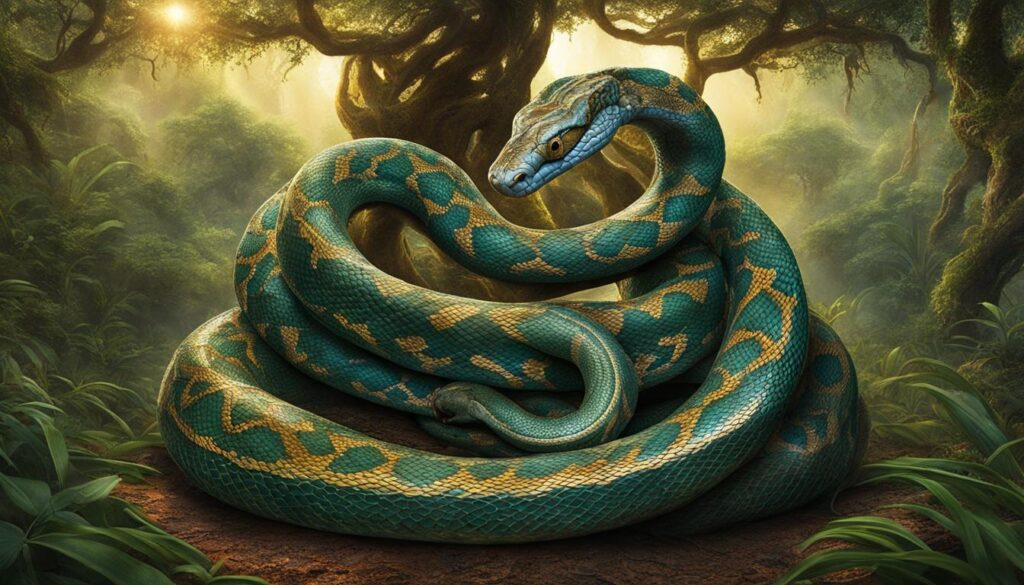
The snake is one of the oldest animals on earth, and it arouses fear and fascination. It is mysterious, intimidating. We fear it because it moves on its belly, without feet, because it lives alone and represents a permanent danger to living beings.
This animal, which sheds its skin without ceasing to live, is considered immortal.
The cosmic ouroboros of Egyptian mythology is a captivating example. A snake with its tail in its mouth, seeming to swallow itself, without beginning and without end, can be, like the circle or the sphere, a symbol of eternity.
 The ouroboros is an eternal symbol of cyclical renewal, embodied as a snake devouring its own tail. This image has transcended time and cultures, conceptualising life as an endless circle of destruction and rebirth.
In examining the Ouroboros, we are compelled to confront our own vulnerabilities and to recognise the perpetual dance of change that permeates the cosmos. On the other hand, Dahomey, in its Creation, speaks of the fascinating figure of the snake, the god Dan, who represents spiritual connections and is also known as the Cosmic Serpent.
The existence of these snakes in creation myths shows the power of the ties that unite the various African traditions.
The links between the visible and hidden aspects of existence and the complex balance of life.
In the so-called Abrahamic religions, the snake represents the devil, the evil spirit.
In other cultures, it symbolises eternal renewal, longevity, wisdom and immortality.
It plays an essential role in the balance of the world and has even, in some cases, taken part in its genesis.
Genesis of the world
The Vodun traditions of West Africa include the snake cult that is probably the best known on the African continent, that of Aido-Hwedo, the rainbow serpent.

Aido-Hwedo plays many roles in different versions of Vodun; for example, in the Dahomean religion (precursor of modern Vodun), she carried in her mouth the creator spirit Mawu-Lisa (formed by the energies of Mawu and Lisa, twins born of Nana-Buluku, the greatest goddess). Mawu-Lisa peopled the earth with life while Aido-Hwedo dug valleys in the landscape with her sinuous snake movements, forming mountains and hills with her excrement.
Aido-Hwedo also appears in Haitian Vodou, a religion related to Vodun.
In the Fon religion, Aido-Hwedo was created to serve Nana-Buluku by supporting the sky. The Fon say that, when the world had been created, the snake gathered the earth between its coils and gave men a place to dwell. The coils of Aido-Hwedo are thus distributed three thousand five hundred above the earth, three thousand five hundred below.
According to another version of the legend, the snake raised four pillars, one at each of the cardinal points, to support the sky, then, to keep the pillars upright, it coiled around them. The three primary colours, black, white and red, are the garments the snake successively wears at night, by day and at dusk, and they are wound around the pillars of the sky.
In the beginning, the snake found only stagnant water on earth, so it traced the courses of the rivers and the beds of the streams; that is how the world received life.
The snake carried the Creator across the world; mountains were born each time they stopped. According to another version, the snake was created first, then it set off, holding in its mouth the Creator who created the world, giving it the shape we know. Each night, when they stopped, the snake’s excrement piled up into great mountains. That is why, when men dig in the mountains, they often discover treasures.
When the Creator had finished his work, he saw that the mountains, trees and large animals were too many for the earth to bear. How could he keep it from sinking into the sea surrounding it? He asked the snake to coil upon itself, its tail in its mouth, to support the earth. And the snake took the shape of those circular pads that humans place on their heads to carry jars or other heavy loads.

The snake does not like heat and finds in the sea the coolness it wants. God ordered red monkeys living in the sea to make iron bars to feed the snake when it was hungry. Each time the snake changes position, an earthquake occurs. If the monkeys forget to feed it, the snake will be forced to eat its tail. In that case, the earth, whose load of men and houses has grown since the beginning, will sink into the ocean; it will be the end of the world.
The python cult
The python cult is widespread across the African continent. Practices vary from region to region. In some regions, people are put to death if they kill a python. In others, pythons have their own hut and a priest or priestess who feeds them tethered animals or sacred milk. While each region presents interesting variants of the python cult, one of the most interesting is north-western Botswana. This is not because of what the San do now, but because of the antiquity of their rituals.
The python is one of the most important animals for the San. According to their creation myth, man descends from the python and the ancient dry watercourses around the hills are said to have been created by the python as it circled the hills in its ceaseless quest for water.
 Researchers found a large rock about six metres long and two metres high, with man-made indentations that give it the appearance of a snake. They began to dig at the snake’s mouth and found many arrowheads, coming from hundreds of kilometres away, which had been “sacrificed” to the snake. The red points were burnt, the others were buried. Dating of this ritual goes back about 70,000 years. Inside the cave was a small chamber, where shamans are thought to have hidden to speak to the faithful. It may be one of the oldest ritual sites in the world, which is simply incredible.
The Ashanti myth
Among the Ashanti, located in present-day Ghana, a man and a woman came down from the sky, while another man and another woman came out of the earth. These were the two primordial couples.
The “Lord of the Heavens” also sent a python (a non-venomous snake of Africa), which made its home in a river. At first, the men and women had no children, they had no desire for each other and did not know the process of procreation and birth.
It was the python who taught them. He asked the men and women whether they had children and, when told they had none, the python said he would make the women conceive. He told the couples to stand face to face, then he went into the river and came out with his mouth full of water.
He sprayed it on their bellies, saying “Kus, kus” (words still used today in clan rituals).
The python then told the couples to go home and lie down together, and the women conceived and gave birth to children.
The children and their descendants took the Python (“spirit of the river”) as their “clan spirit”.
Killing or injuring a python is taboo, and if they find a python dead or killed by someone else, they cover it with white clay and bury it as one would bury a person.
The Soninke myth
Wagadu Bida is probably one of the snakes whose story is best known. Bida is a great snake that lived in a cave in the Sacred Forest. He was the protective spirit of the Soninke.

Each year, the latter had to sacrifice the most beautiful girl of Koumbi Saleh. But one year, the Elders’ choice fell on the beautiful Sia, who was already engaged to Amadou Séfédokoté, that is, “Amadou who speaks little”. The fiancé, who loved the beautiful Sia very much, became inconsolable at the thought that his betrothed was to be the prey of Wagadu-Bida. He refused to submit to the Elders’ choice.
On the day of the sacrifice, he hid behind a tree and, at the moment when the great snake came out of its cavern, he cut off its head with one stroke of his sabre. But at once another head grew back, while the first, whistling through the air, went to fall in Bouré: that is why this country is rich in gold. Amadou cut off the seven heads of Wagadu-Bida in succession.
Each of them fell in a region that has since become rich in gold; one fell in Bambuk, another in the Falémé river. When the seventh and last head was cut off, the snake collapsed. Amadou carried off the beautiful Sia at a gallop on his great horse, while the whole people of Koumbi Saleh, in tears, cursed the criminal. After the death of Wagadu-Bida, drought struck the land, the sown grain no longer grew, the herds were decimated by thirst, and the terrified Soninke scattered.
Conclusion
In myths, then, there is no fixed place for the snake. It arouses admiration, but also fear and respect because, although often at the origin of the world or of civilisation, it also holds within it the potential for annihilation. That is probably why it is still today the object of various rites and taboos across many cultures of the African continent.
Bibliography and websites:
African mythology – G.Parrinder
Lilyan Kesteloot and Bassirou Dieng, Les épopées d’Afrique noire, Paris, Karthala-Unesco, 1997.
https://www.gateway-africa.com/stories/Ashanti_on_procreation.html
Wilfrid D. Hambly, Serpent Worship in Africa, vol. 21, coll. “Publications of the Field Museum of Natural History. Anthropological Series, vol. XXI, No. 1 “,
Le culte du serpent en Afrique noire – A.Dommerges


