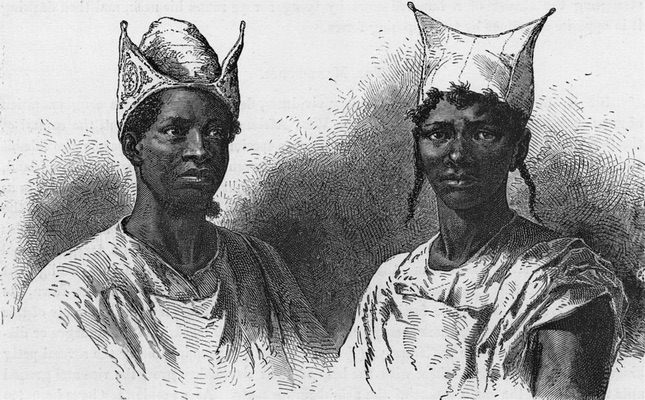
” Coulibaly massasi! Coulibaly Bitonsi! ” Amadou et Mariam, Coulibaly, 2004.
We could not have dreamed of a better opening than these song lyrics by the Bagayoko couple to introduce our subject. In their song Coulibaly, Amadou and Mariam praise the descendants of the founder of the Bambara kingdom of Ségou (Sègu), Mamary Coulibaly, known as Biton Coulibaly, who reigned from 1710 to 1755.

He is seen as the spearhead of a kingdom that lasted until the early 1860s.
Sègu is a town north-east of Bamako, in the Macina region of Mali. The Bagayoko couple remind us that the Coulibalys descend from the line of kings, “Massasi “, and from the line of Biton, “Bitonsi“.
However, the word kingdom needs qualifying. The exact term for the Bambara Kingdom would be Sègu Fanga, meaning “the force” of Ségu because authority was established by violence. In Bambara we no longer speak of a king but of a “Faama“, the holder of force.
The Bamananw of Sègu were organised hierarchically into social groups, following three principles. The sègukaw were divided into the “horonw“, or the free. The “Nyamakalaw“, also called people of craft, grouped together the “Jéliw” and the “Numuw“, the griots and the blacksmiths. The “Jonw” were slaves employed as soldiers. Their armed body was called “Tonjon“, the association of slaves, and was led by a “Tontigi“, the head of the association, that is, the Faama.

The Bamananw of Sègu followed principles: the first being “Né bè boliw son“, that is, to sprinkle the fetishes (Boliw) with blood, which refers to carrying out sacrifices for the fetishes.
The second: “Né tè siran Ala ɲè” or “I do not fear God” (Ala). And finally “Né bè dolo min”, the equivalent of “I drink dolo”, an alcoholic drink made from millet.
With these preliminary facts we can best analyse our subject in order to study and understand the relations between magic, traditional cults and Islam in the Sègu Fanga. We will first see that the Sègu Fanga rested on traditional cults and beliefs of its own. Finally, we will study the notion of Islam in Sègu.
I- The ” banmanaya ” between traditional cults and magic:
First, let us see who the Bamananw are, to best study their society.
According to the French anthropologist Jean Bazin, in his essay on the Bambara, À chacun son Bambara. The author writes that, depending on the moment in history, the description of the Bamanan changed. In his essay we go from a “conquering race” described by Heinrich Barth in the 19th century, to thieving farmers who had to be tamed during the colonial conquest.

The Bamananw were either “solid riflemen” or described as “thinkers”, as the French ethnologist Germaine Dieterlen wrote in La Religion Bambara.
This name has several meanings because of the porosity of ethnicity in these civilisations. They were described as bamananw either by their activities or by the view other peoples or ethnic groups had of them.
However, even if the exact definition of Bamanan remains abstract, one thing is unanimous.
The Bamanan is unsubmissive to the religions of the book, which is expressed by the prefix “Ban” meaning refusal, and “Mana” meaning the master, interpreted as “unsubmissive to Islam”.
The Bamananw practised traditional cults around the boliw within the Sègu Fanga. We can give the example reported in Acteurs et Valeurs dans l’épopée Bambara de Ségou, published in volume 6 of the Canadian Journal of African Studies in 2009 by Lilyan Kesteloot.
“Monzon will capture two of his village chiefs to sacrifice them to his fetishes at his wedding, without this fact drawing the slightest criticism from the griot who tells the story today. The chief may abuse, it surprises no one.” page 33.
It was thanks to the boliw that the Faama held his power and could then use the Fanga to subdue the villages and other spaces he managed to extend into.

The weight of this submission was marked by one thing: the tax more commonly called Disongo, the price of honey. Honey was used in the making of alcoholic drinks, Dikolen or “washed honey”. With the peak of the Sègu Fanga, this Disongo gradually turned into Nîsongo, the price of the soul.
With these two aspects of Bamanan society in Sègu we come back to the principles stated in our introduction, to recall: “Né bè boliw son“ and “Né bè dolo min”. As for the second principle, also the most fundamental for our subject, namely “Né tè siran Ala ɲè”, it takes on its full meaning when we look at Bamanan cosmogony. They believe in a creator god who was named Ngala in Sègu. We specify the geographical area because regions far from Muslim influence kept the terms Ka and San for the sky and God, as Tal Tamari explains in the mid-2000s in chapter eleven, titled Les religions au Mali, cent-vingt ans de regard ethnographique, of her work Hommes et sociétés. The Bamananw neither pray to Ngala nor fear him. This absence of fear is illustrated in a Charlie Hebdo article by Francis Simonis, of 22 August 2018: Da Monzon Diarra ou la force de Ségou. In one passage, the lecturer recounts an event that took place under the reign of Da Monson Diarra (1808-1827). Faama Da is said to have ordered the tonjonw to aim their guns at the sky and fire, to show God that he was stronger than him.
However, the sègukaw were wary of the genies and other divinities around them, such as those of the Niger river like Fâro.
Fâro is described on the site Nofi Média, created by Christian Dzellat-Nkoussou and Doudou-Jacques Faty, as “master of the Word, father of all the divinities of air and water, he sits enthroned in the seventh heaven and sends the beneficial rain. His colour is white. It is Faro who created the first woman, Mousso Koroni, nourishing earth, mother of humanity.”
Moreover the sègukaw could be led to negotiate with them, as was the case for the first Faama of Sègu. This passage of the creation of the Sègu Fanga is illustrated in Boubacar Sidibé’s series: Les rois de Ségou.
After making a pact with Fâro, Biton received powers and the guarantee of being a powerful man if he followed the advice of the water genies.
By keeping a privileged bond with Fâro, the Faama was also jitigi ni môgôtigi, master of the waters, therefore of the river, and also of men.
Yves Person, a former colonial administrator and professor of African history, in his synthesis Ngolo Jara ou la force de Ségou, refers to the myth of the gold ring of Ngolo Diarra (1766-1790).
Given as tax by his family to Biton Coulibaly, Ngolo had been entrusted with a ring by the Faama. After his brothers stole it and threw it into the river, Biton condemned him to death. It was by eating a fish before his execution that he found the ring again and escaped death. Let us interpret this as a way of legitimising the link of the Ngolosiw with Fâro, because in Sègu nothing happens by chance. This relationship to magic is such that when a Faama dies, the reason for his death is linked to the fact that his boliw no longer protected him. “It is not gods who fall, but men who have lost their strength…” Lilyan Kesteloot, Acteurs et Valeurs dans l’épopée Bambara de Ségou, p.34.
When the tonjonw went to war against a neighbouring town and lost a battle, a ritual of gestures or words was performed on the advice of a marabout.
“It is the magic of a fetish priest […] that will overturn the obstacle.” Lilyan Kesteloot Acteurs et Valeurs dans l’épopée Bambara de Ségou, p.37.
The marabout gave a list of tasks to carry out to counter the powers of the boliw and of the Faama targeted. “Before defeating your enemy physically, you must defeat him magically!” F. Simonis, Da Monzon Diarra ou la force de Ségou.
These rites and beliefs of the Bamananw led to the making of masks in the likeness of certain animals which eventually became the symbols of initiatory societies such as the Ciwara, or “straw animal”, of the Kono society.

If the marabout is seen as an intermediary between invisible forces and humans, the Donso, the hunter, has this gift too.
The donso is confronted daily with occult forces and with the nyama, the soul, of the living beings he hunts.
He is also known for his qualities as a healer. It is very likely that Biton Coulibaly was one before he came to power.
All that we have just described forms the banmanaya, the Bamanan attitude that comes into confrontation with the Islam carried from the north of the Sahara, but the relations between the Bamananw and Muslims were more complex than one might think.
II- Bamanan and Islam: an impossible marriage?
For followers of the religions of the book, the Bamananw are kouffar.
The Bamananw themselves are extremely tolerant towards those whose cults are different.
Biton Coulibaly had a mosque built for his mother without being Muslim himself. The practice of other cults alongside the Bambara cults was normal in the Sègu Fanga. The Julaw, traders from the south whose language is similar to Bambara, and the surakaw and burduamew (Arabs and Tuareg) lived in Sègu and were bound together by Islam.
The Peul subjected to the Sègu Fanga were Muslim, but used Bambara as a lingua franca. These communities were not the only ones practising Islam in Sègu; the Saracolé and the Soninké, often called Marka, also define themselves by this religion.
It was Muslim marabouts who made amulets and other protections with Quranic verses and drops of water that had served to wash the wooden tablets on which verses were written (Basiji).
The leather bracelet of Da Monzon Diarra, reported by Jean Bazin in his book titled La construction d’un récit Historique on p.441, is a perfect example. “In the meantime, Faama Da had had a spell made for him by the mori (marabouts); they had provided him with a leather bracelet that he wore on his right arm.”
“Then Faama Da, with his spell on his arm […] The leather bracelet swelled and burst; it came off his arm, turned red as fire and finally plunged into the river.”
It was practical for nomadic communities to be Muslim, because it is difficult to take one’s boliw along on journeys of several days or weeks.
Tal Tamari adds this on page 269 of Les religions au Mali, cent vingt ans de regard ethnographique: “we have shown that many elements of the liturgy of the traditional religions correspond to statements of the Quran or of Muslim scholastic theology. “
She continues: “Let us add that the altars of the Bambara initiatory societies of the Kànà, […], resemble miniature mosques; that when looking at photos of the kara, those long wooden boards on which signs meant to be “read” are frequently engraved or drawn, it is hard not to think of Quranic tablets, […], and finally that it is not insignificant that many cult objects, […] are supposed to come from Mecca. “
An example is given in Yves Person’s synthesis, Ngolo Jara ou la force de Ségou, on page 297, where the author describes a passage in the life of the future father of the Ngolosiw. After being sent away from Sègu, Ngolo Jara was attached to a caravan with slaves. He was even about to be sold as a slave, “But the town’s imam took him in, taught him the Quran and, considering him converted, freed him…”
This episode in Ngolo Jara’s life shows us that what was supposed to act as a border with the traditional cults of the Bamananw can be a bond between two world views.
We have a double view of the facts: on one side, the Bamananw of Sègu with their traditional cults and beliefs, while certain writings like those of Tal Tamari or other sources describe a banmanaya deeply imbued with Islam. However, if we analyse our subject in depth, the facts suggest that the traditional sègukaw religions had a deeper anchorage. Islam often imposed a bureaucracy and the making of written records, yet in the case of Sègu the only written records that remain are those of Arab or European travellers written between the 16th and 19th centuries, such as the description by Mungo Park.
Conclusion:
In short, we can say that traditional cults and Islam in Sègu are two distinct world views within this political entity, even if it seems hard to us today to imagine a return to the “big screen” of these ancient cults in a society that is more than 90% Islamised. The tolerance of the Ségovians towards other cults, which they associated with magic, as well as the establishment of an “Africanised Islam”, or one leaning towards Sufism, seem to be elements that allowed this coexistence. The bamananw had their boli huts and the Fulanw, Marka, Burudamew and Surakaw communities had the mosques in Sègu.
But this balance between Islam and traditional cults was shaken after the defeat of Sègu by the Peul in 1818 and the submission to the Toucouleur empire in 1861 by El Hadj Oumar Tall.
Bibliography and webography:
J.BAZIN, Bambara : paysage politique, rites et croyances, Encyclopédie Universalis : https://www.universalis.fr/encyclopedie/bambara/2-paysage-politique-rites-et-croyances/
T.TAMARI, « Les religions au Mali, cent vingt ans de regard ethnographique », in : Hommes et sociétés, Karthala, Paris, 2016, p239-292.
L. KESTELOOT, « Acteurs et valeurs dans l’épopée bambara de Ségou », Revue Canadienne des Études Africaines [online], 1972, Vol. 6, No. 1, http://www.jstor.org/stable/484150 (accessed 06/03/2024).
F.SIMONIS, « Da Monzo Diarra ou la force de Ségou », Charlie Hebdo [online], 2018,Ep.7, No. 1361, https://charliehebdo.fr/2020/08/societe/grandes-figures-histoire-afrique-episode-7-da-monzon-diarra-ou-la-force-de-segou/ (accessed 05/03/2024).
C.DZELLAT-NKOUSSOU ; D-J.FATY, Nofi Media : Les Bambara [online], 2014. https://www.nofi.media/2014/10/les-bambaras/1766 (accessed 05/03/2024).
J.BRUNET-JAILLY, J.CHARMES, D.KONATE, Le Mali contemporain, Éditions Tombouctou, Tombouctou, 2014.
Y.PERSON, Ngolo Jara ou la force de Ségou, Jeune Afrique, Paris, 1978.
J.BAZIN, A chacun son Bambara, Poche/Sciences Humaines et Sociales, La Découverte, Paris, 2005.
J.BAZIN, Cahier d’études africaines : la production d’un récit historique, 1979.
L.KESTELOOT, A.TRAORE, J-B.TRAORE, A.H. BÂ, Da Monzon de Ségou, Nouvelle Édition Numérique Africaine, Sénégal, 1905.
B.SIDIBE, Les rois de Ségou [vidéo], Office Radio Télévisé du Mali, Brico Films, Sarama Films, Mali, 2010, (26 épisodes de 21 minutes).
B.DIAGNE, « N’tomo, société d’initiation des enfants mandingues », Histoires d’Afrique [online], 2023,https://hida-media.com/en/2023/01/17/the-n-tomo-initiation-society-of-mandinka-children/ (accessed 05/03/2024).


