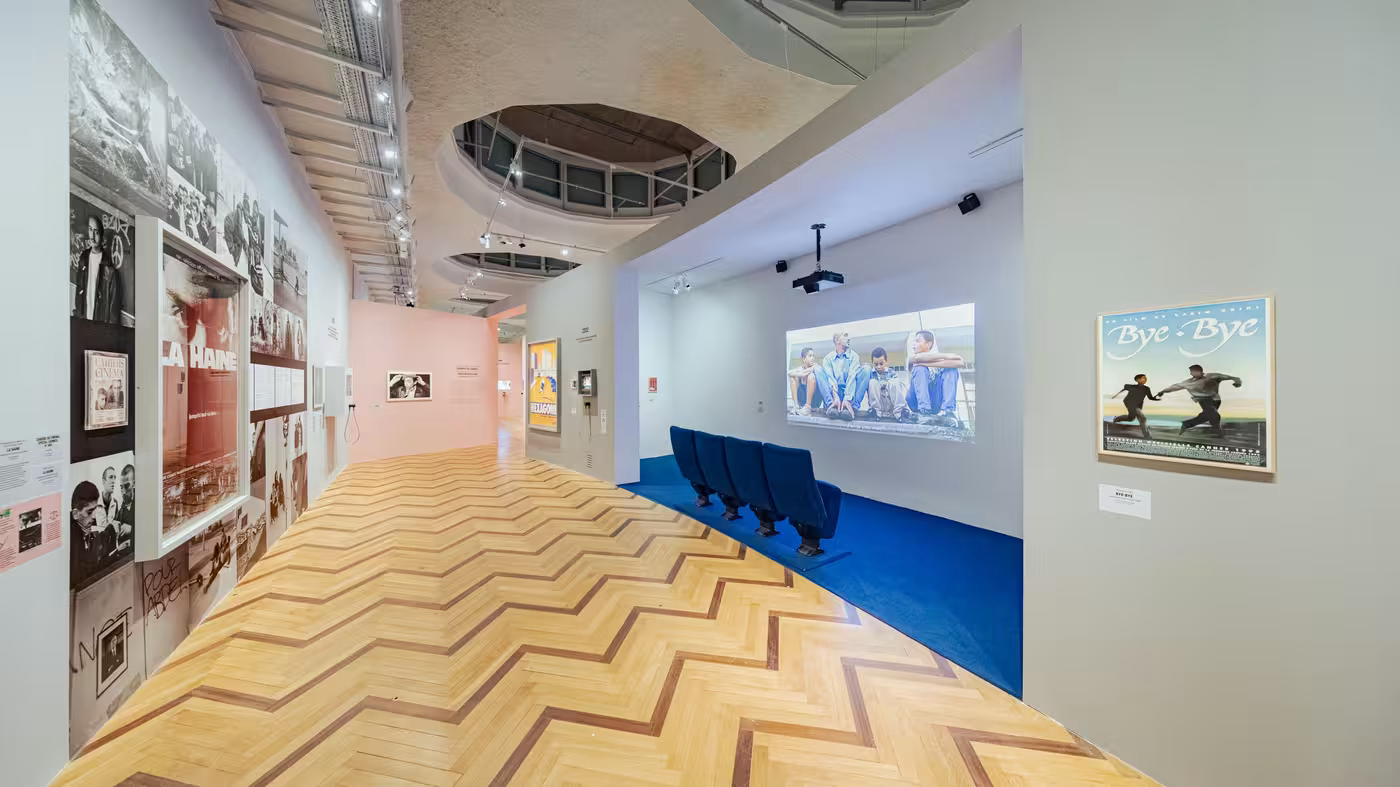
At the Palais de la Porte Dorée, the exhibition “Une histoire du cinéma français. Héritages maghrébins” does not only set out to look at how North Africans have been represented on screen: it aims to highlight the contribution of Maghrebi artists to the history of French cinema.
A shift in perspective
That, in any case, is the wish expressed since the opening – on 30 October, at the Musée national de l’histoire de l’immigration at the Palais de la Porte Dorée – of an exhibition dedicated to the Maghrebi legacies of French cinema. Its title, “Une histoire du cinéma français”, already states the ambition: this is not a separate chapter, but the history of French cinema itself.

The museum explains its approach. Rather than focusing on figures of immigration as they have been represented on screen, the exhibition sides with the artists who, since the 1960s, have written large parts of this history and whose role remains to be brought to light. The question is no longer only how North Africans were filmed. It becomes who made cinema, and with which stories.
Images that repeat themselves
In part of French cinema, Maghrebi characters have long been associated with a handful of figures: the immigrant worker, the authoritarian father, the traditional mother, the young person from a working-class neighbourhood, the character confronted with precarity. Showing these realities is not problematic in itself. The issue arises when they end up forming most of the imagery associated with an entire population.
Through repetition, a small number of roles comes to stand in for a collective portrait. Yet Maghrebi stories in France, in their trajectories, their belongings and their relationships to the country, are many. Reducing them to immigration, the banlieue or identity questions means missing a large part of these experiences.
Stories were also told from within as early as the 1960s.
After the independences of Morocco, Tunisia and then Algeria, filmmakers from the Maghreb arrived in Paris. They trained, notably at the IDHEC, the forerunner of La Fémis. Some went back, others settled. An intellectual diaspora formed around the cinemas of the Quartier latin, the film clubs and the magazines.

It is in this context that the exhibition places Ali Ghalem, whom it presents as a pioneer. His film Mektoub ? looks at the experience of Algerian immigration in France. French filmmakers also took up the subject, such as Michel Drach with Élise ou la Vraie Vie (released in 1970) or Yves Boisset with Dupont Lajoie (released in 1975). These perspectives coexist, and that is precisely what the exhibition allows us to distinguish: a film about immigration is not the same gesture depending on who makes it and from where.


From the 1980s onwards, films such as Le Thé au harem d’Archimède by Mehdi Charef (released in 1985) made new voices visible, with stories tied to migratory trajectories, working-class neighbourhoods and multiple heritages. These works do not tell the same thing and cannot be reduced to a desire to correct images.
Beyond the question of origin
Over the decades, the stories have diversified: family relationships, colonial legacies, transmission between generations, multiple belongings, relationships to language, intimate experiences. The exhibition has set out to follow this variety throughout its itinerary. The museum names among the filmmakers Rachid Bouchareb, Yamina Benguigui, Hafsia Herzi, Naceur Ktari and Lina Soualem, and among the actors Jamel Debbouze, Rachida Brakni, Roschdy Zem, Samir Guesmi and Sami Bouajila.

Cinema is also a space of memory, transmission and emancipation. It is both an actor and a witness to the issues of its time, and sometimes a lever for justice.
This year, twenty years after the release and the triumph of Indigènes by Rachid Bouchareb, the place of cinema in the recognition and transmission of history remains a burning question. The catalogue, edited by Ahmed Bedjaoui, Marie Pierre-Bouthier and Salima Tenfiche, extends this reflection with articles, focuses on films, biographies and interviews.
This does not mean that a filmmaker could only tell their own experience, nor that an origin determines a perspective. A character can be in love, funny, ambitious, fragile or simply ordinary without their origin being the subject of their story. They can occupy the leading role without being the embodiment of a community.
Being represented on screen does not mean being represented in all one’s complexity, but this exhibition has the merit of having raised once again within us the following question: what have we really paid attention to during these 70 years of North African cinematic history in France?
What have we decided to look at, to make identifiable, to highlight and to celebrate? All of this perhaps says more than the trajectories of the artists themselves.
SOURCES
- Musée national de l’histoire de l’immigration – exhibition page “Une histoire du cinéma français”
- Musée de l’histoire de l’immigration – section “1960-1980: exils et contrechamps”
- Exhibition catalogue page (Éditions de La Martinière)
- Élise ou la Vraie Vie, Unifrance (released 25 November 1970)
- Dupont Lajoie, AlloCiné (released 26 February 1975)
- Le Thé au harem d’Archimède, Cinémathèque française (released 30 April 1985)


