Little is known about the cultivation or use of cotton in Africa until the 11th century CE, when it must have been widespread, at least in West Africa.

Large quantities of cotton (and wool) textiles with very varied patterns, pointing to a well-developed textile industry remarkably similar to today’s, were found during excavations of archaeological deposits from this period in the caves of the Bandiagara escarpment in Mali, now the region inhabited by the Dogon people.
West Africa was without doubt one of the world’s main centres of cotton cultivation. It is regrettable that the colonial powers made so much effort to subvert local culture, efforts which, for one reason or another, have largely succeeded today.

Cotton was also grown and woven in Sudan, Somalia and Ethiopia. Cotton fabrics already existed at Meroë from at least the early 5th century. It is also found further south in East Africa as far as southern Zimbabwe, and in Madagascar, where it was introduced by early European visitors.
Preparation

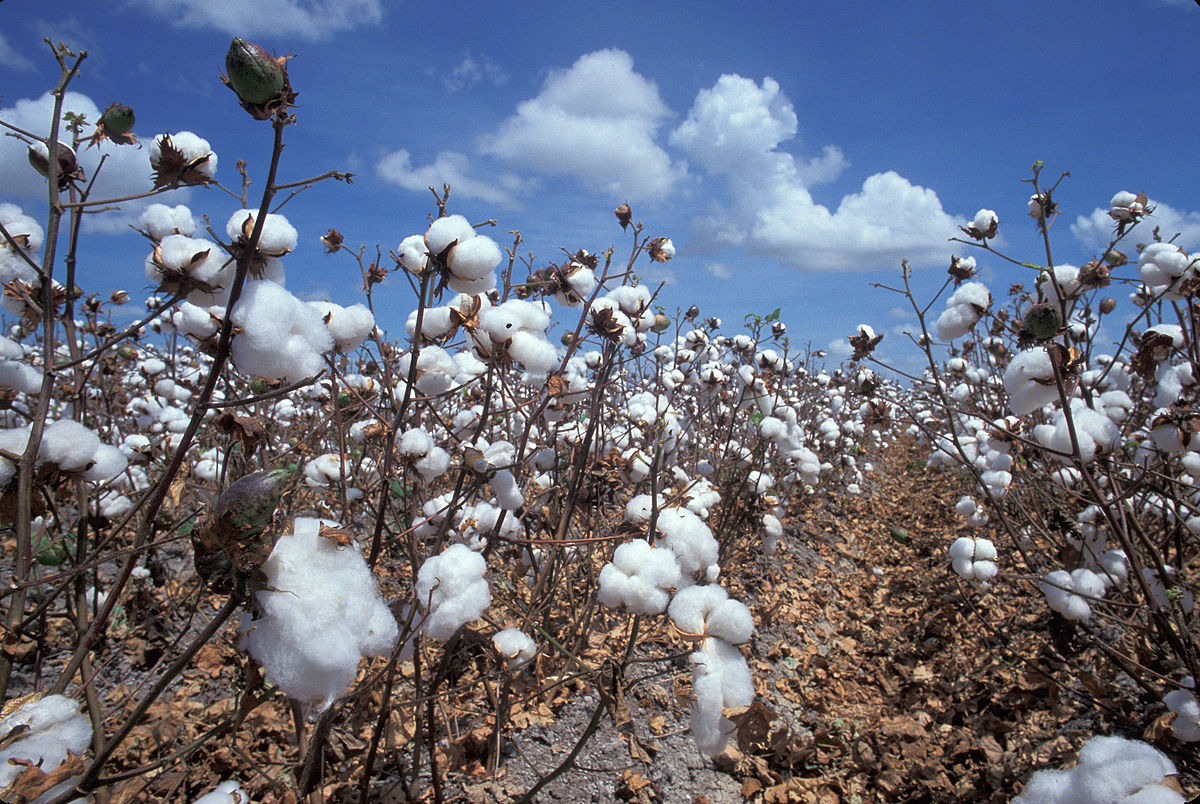
Cotton thread is spun from the mass of fibres (the boll) surrounding the seeds of the cotton plant, of which there are several species of the genus Gossypium. The first step in turning the bolls harvested from the plants into thread suitable for weaving is ginning, that is, removing the cotton seeds.
A few bolls are placed on a block of wood, or in some regions on a flat stone, and their seeds are squeezed out by rolling an iron rod over them, or sometimes a wooden stick. The fibres must then be disentangled. This can be done simply by pulling the bolls apart by hand, but the most common method is the bow. The string of a small bow is stretched against the cotton, striking it and fluffing it into a large loose mass.
The technique of spinning the cotton fibres, once they are loosened enough, is practically the same as that used by Berber women to spin their wool warp threads. The same three movements are observed and the spindle turns either freely in the air or in a cup. The cotton is held in the left hand and supported or not by a distaff. With the right hand, the spinner turns, pulls down and controls the twist. She may have a small pot of fine ash in which she periodically dips the finger and thumb of her right hand to stop them sticking to the cotton fibres.
Cotton fibres naturally grow in several colours. White is the usual colour, but pale brown is also common. Brown can also be obtained from several plant dyes, as can many other colours, which will be described below.
Changing uses
In Ghana, difficulties in producing a good red dye led Asante and Ewe weavers to unravel imported red cotton cloth, and in some parts of Nigeria red hospital blankets were unpicked to reweave the thread thus obtained.
At present, factory-spun and dyed cotton thread, as well as rayon and lurex, in a wide range of bright colours, have largely replaced hand-spun cotton, except where it is significant in a ceremonial or prestige context. Factory-woven cotton shirts are also widely used to make garments to local designs and by Senegalese and Yoruba dyers for indigo resist dyeing.

Imported cottons have replaced many woollen garments in North Africa.
Originally very expensive, so that only the rich could afford to buy them, cotton garments are now cheaper than hand-spun wool and husbands are only too happy to buy such items for their wives, who still regard them as luxury goods, even though they offer only ineffective insulation against the Moroccan winter.
In spite of all this, the history of cotton cultivation and textile production in Africa reveals a rich tapestry of innovation and tradition that has spanned the centuries.
From the earliest traces of cotton cultivation to the discovery of complex textiles in the Bandiagara escarpment in Mali, the continent has been a major hub for growing and weaving cotton.
Despite the challenges posed by colonial interference and the subsequent decline of local cultivation efforts, the legacy of African cotton production remains a testament to the resilience and creativity of its people.
From Sudan to Ethiopia, from Somalia to Zimbabwe and even Madagascar, cotton cultivation and weaving have left an indelible mark on the continent’s cultural landscape.
As imported cottons replaced woollen garments in North Africa, the accessibility of cotton clothing widened beyond the elite to reach a larger part of society. Today, the tradition of cotton growing and textile production in Africa continues to evolve, blending ancestral techniques with modern innovations to create a dynamic and diverse textile industry that reflects the continent’s rich heritage and spirit of ingenuity.
It has gradually become a structuring element of agricultural production systems and local economies. Thus, the cotton basin of the African CFA franc zone saw its share of sub-Saharan cotton production rise from 13.5% in 1970 to about 65% in 2018–2019.


