Opening of the 5th edition at Eko Atlantic City
Under the title The Museum of Things Unseen, the 2026 edition, open to the public from 14 November to 6 December at Eko Atlantic City, brings together works that have rarely or never been shown and examines why they have so seldom been seen. More than the works themselves, the biennial has this time set itself the mission of questioning the entire sector, with its choices of collecting, conservation and display.
A construction around the theme of absence.
The curatorial text starts from a hypothesis: that of a museum freed from structural inequalities. These are not abstract accusations. The global art sector’s imbalances have been widely documented: works by African or Afro-descendant artists make up a marginal share of the permanent collections of major European and North American museums, and when they do feature, it is often through acquisition logics that passed through colonial periods or within recent “diversity” margins. By building a speculative version, temporary but concrete, in which works are chosen for what their absence reveals, the biennial positions itself as a space that questions the museum space itself, with its policies of collecting, conservation, display and access.

The setup rests on a second gesture. Contemporary artists are invited to reinterpret these works, that is, to respond to their sidelining rather than merely observe it. The first list published by the biennial counts seventeen names, among them Kara Walker, Hito Steyerl, Antoni Muntadas, Amie Siegel and Lagos Studio Archives. Parallel pavilions, including that of the European Union, complete the exhibition. An international symposium on the circulation of heritage, restitution and the idea of the universal museum accompanies the whole.
The choice fell on Eko Atlantic: a new district risen from the water
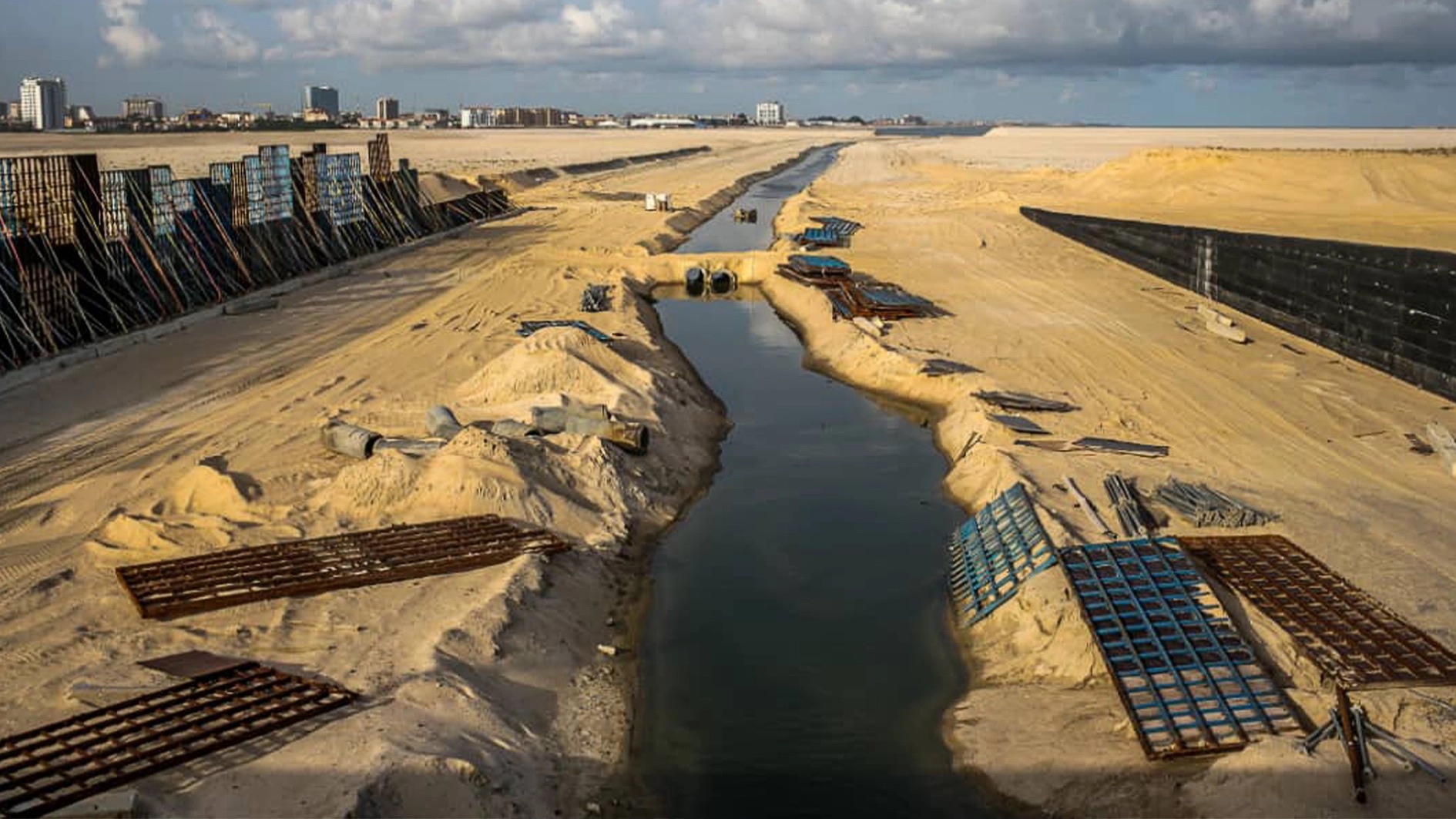
Eko Atlantic City is a planned district, reclaimed from the Atlantic Ocean off Victoria Island. Landfill and coastal protection works began around 2008-2009, less than twenty years ago. For Folakunle Oshun, founder and artistic director of the biennial, setting the exhibition there makes it possible to reflect on the relationship between the fast-changing urban landscape of Lagos and its cultural memory.

This choice breaks with previous editions, which occupied places steeped in political history. The Nigerian Railway Corporation hangar in Yaba, built in 1955, hosted the first in 2017. The second took place in Independence House, an abandoned twenty-five-storey tower given to Nigeria by the British colonial administration at independence in 1960. The fourth, in 2024, occupied Tafawa Balewa Square, where the independence celebrations and FESTAC ’77 events took place.
Eko Atlantic offers no building inherited from that political history. The biennial moves from reoccupying existing places to settling in a district still under construction. This does not mean the place has no history, only that it is not inscribed in visible walls. The theme of memory and erasure therefore arises differently, on land reclaimed from the sea rather than in a building loaded with symbols. It remains to be seen how the exhibition fits into a project that the Nigerian press describes as one of the most ambitious urban development schemes in Africa.
Lagos is one of the largest urban areas on the continent, and estimates of its population vary widely depending on the source, from around fifteen to twenty million inhabitants. Its contemporary scene has been structured mostly outside public institutions, around private foundations, non-profit organisations and artist-run spaces, such as the Centre for Contemporary Art, Lagos, associated with curator Bisi Silva, or the African Artists’ Foundation and its LagosPhoto festival.

The ÀKÉTE Collection: an artistic but also institutional project.
The stakes go beyond the duration of the exhibition. With the Àkéte Collection, unveiled on the occasion of this 5th edition, the biennial lays the foundation stone of the museum of modern and contemporary art it wants to open in Lagos, in a dedicated pavilion that does not yet exist. The collection brings together works from the first four editions, notably by Demas Nwoko, Victor Ehikhamenor and Tabita Rezaire, as well as acquisitions, donations and long-term loans from artists, international museums, private collections and individuals.
The biennial presents it as a major international collection of modern and contemporary art based in Africa, and its curators speak of a pioneering international public collection on the continent.
This construction rests on a singular economy. Founded by artists in 2017, the biennial is a non-profit platform of the Àkéte Art Foundation; its successive venues were obtained through long negotiations with public authorities, and it is endorsed by the Lagos State Ministry of Tourism, Arts and Culture. For the future museum, the resources highlighted by the foundation are donations, loans, including from foreign museums, and the sale of a bibliophile object.

We recall that, on 4 November 2025, at the MUSON Centre in Lagos, the foundation launched the publication The Making of An African Capital of Culture (Lagos Biennial I–V), before an audience of diplomats, collectors and art professionals.
This step was crucial in raising funds for the new museum. The book is in itself an exceptional collector’s piece. Only 65 limited-edition copies were printed in the United Kingdom.
Designed by British graphic designer Kieron Lewis and printed in a run of 65 copies, 50 of them offered to the public, the book is housed in a sculptural case made of seven kilos of hand-cast concrete, whose cover reproduces the façade of Tafawa Balewa Square, symbol of Nigerian independence and site of the 2024 edition.
Sold from 7.5 million naira, around 5,000 dollars, with upward price revisions announced and a paperback edition promised for October 2028, it is aimed first at those who can afford to collect.

Folakunle Oshun sees it as “both a documentation and a declaration”: documentation of the first four editions, with contributions from Bisi Silva, Antawan Byrd, Tosin Oshinowo and Yinka Elujoba and a preface by Supo Shasore; a declaration too, because this book already presents itself as a collector’s piece whose sale must finance the museum.
The public programme also brings Nigerian institutions to the table, with a meeting on 16 November on what art institutions produce, where representatives of the National Gallery of Art, the MOWAA Institute and other organisations are due to speak, with some participations still to be confirmed.
This edition therefore plays out on two complementary levels. There is the exhibition, to be seen on site from 14 November to 6 December. And there is what comes after: a permanent venue, a collection and funding that must last beyond these three weeks. The launch of The Making of An African Capital of Culture shows how this next step is being prepared, but also and above all a clear and asserted vision: that of seeing Lagos become home to the next international cultural capital.
SOURCES
- Lagos Biennial, official website
- Lagos Biennial, Àkéte Collection
- Lagos Biennial, curators announcement and curatorial text
- Lagos Biennial, artists announcement
- Lagos Biennial, 2026 public programme
- Lagos Biennial, presentation and history of the venues
- Lagos Biennial, The Making of An African Capital of Culture publication
- The Lagos Review, 10 November 2025, launch of the publication and of the Àkéte Collection campaign
- The Guardian Nigeria, 28 October 2026, remarks by Folakunle Oshun
- African Development Bank, summary of the Eko Atlantic impact study
- 1 Cubic Meter, contemporary art institutions in Lagos
- Zeitz MOCAA, 2017 opening


